Vocal music at Florida State

Mary Mackenzie, soprano, and Heidi Louise Williams, piano, gave a fabulous performance at Florida State University last Friday that featured a big chunk of my song catalog. The program included the sets Holy the Firm and Three Sacred Songs, plus the individual songs Waltzing the Spheres and Shadow Memory. They closed the program with my arrangement of How Can I Keep From Singin’? Mary was in dazzling form throughout, particularly  in the big Holy the Firm cycle, with beautiful singing at the service of formidable emotional impact. She’s done the piece a number of times now, and I liked that she is getting more theatrical in the “mad scene” opening of the cycle’s last song, with its juxtapositions of dreaminess and terror. Heidi’s pianism was no less impressive. She played a Fazioli piano with a slightly glassy and sweet tone that could be clattery in less gifted hands. Heidi commanded complete control of balance, color and dynamics, not an easy thing on any instrument, but especially on the Fazioli.

In addition to my music, the program included John Harbison’s Vocalism: A Grand Aria for Soprano and Piano (that’s the composer’s subtitle) on a Whitman text. It is indeed grand: emotionally big-hearted, vibrantly textured. On a very different scale was John’s Seven Poems of Lorine Niedecker, a work premiered at this past summer’s Tanglewood Festival of Contemporary Music. The piece is a set of seven short songs bound together (played without pause) that can also be understood as one larger song. Mary and Heidi offered a lovely short song by Daniel Crozier as an encore.

I gave a talk on my music the night before the recital. Thank you to Clifton Callender and Michael Buchler for the invitation to speak and for their kind hospitality.

The recital (along with the one the ladies gave at Southern Mississippi University earlier in the week) served as preparation for a CD recording including my music, set to take place next month. On the basis of the concert last week, it will be a remarkable document.

Here’s a post-concert shot, with Heidi on the left:

IMG_1015

Many Songs in Tallahassee and Hattiesburg

I enjoyed two coaching sessions last week with Mary Mackenzie and Heidi Williams. These two ladies will be performing most of my voice and piano song output later this year, and then recording almost all of that material for an eventual CD release. On Friday, November 20, at Florida State University in Tallahassee, they will perform:

  • Three Sacred Songs (arrangements of old plainchant melodies)
  • Holy the Firm (a big cycle I wrote for Dawn Upshaw)
  • the individual songs Waltzing the Spheres and Shadow Memory (texts by Susan Scott Thompson and Susan Orlean, respectively)
  • an arrangement of How Can I Keep from Singin? (dating from some 20 years ago, it was written for an all-Primosch show at the Cleveland Museum of Art)

The performance will also be given at Southern Mississippi University in Hattiesburg on Tuesday, November 17. I’ll be there in Florida, and will give a talk at FSU, but will have to miss my Mississippi debut - I’ll be in NYC for the Juilliard performance of From a Book of Hours.

Both of these women are quite fantastic musicians. I’ve known Mary for some time, and she has done my work beautifully on several occasions, including a performance and recording of my piece for modern instruments, early instruments, and choir, Sacred Songs and Meditations (that recording has been in the can for a while, I imagine the release shouldn’t be too far off.) Heidi was new to me, and she is a real find, getting a beautiful piano sound, capable of subtle rhythmic nuance, ably partnering Mary. The rather virtuosic piano writing in Holy the Firm holds no terrors for her. Check out her very impressive disc Drive American, with music by John Adams, Joan Tower, Daniel Crozier, Chen Yi, Augusta Read Thomas, and William Bolcom.

The individual songs mentioned above are not (yet) handled by Theodore Presser, my usual publisher. Check out sample pages from these songs on the score excerpts page. There is a recording of Shadow Memory (Lisa Williamson, soprano and Rami Sarieddine, piano) on the “solo voice” audio excerpts page. A video of Kelly Ann Bixby, soprano, and Laura Ward, piano, doing Waltzing the Spheres is here. Send me an e-mail <jamesprimosch at gmail dot com> if you want purchase PDFs for any or all of these individual songs - click on the titles above to purchase the cycles.

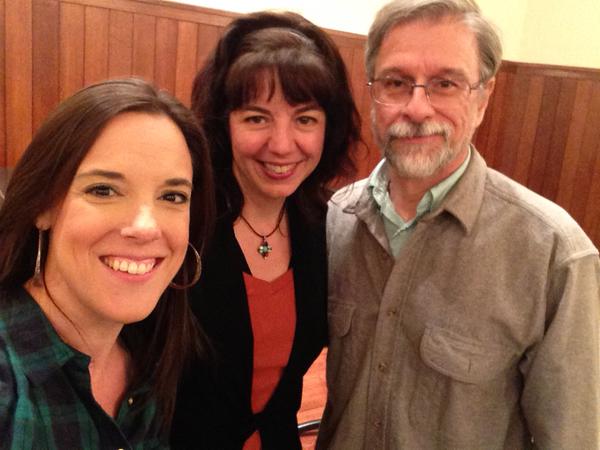
Here is the inevitable post-coaching selfie. That’s Mary on the left, then Heidi in the middle.

CQQXbv_UYAAbcwg

Upcoming this season in Athens, Tallahassee, and Philadelphia

I want to call your attention to a couple of items recently added to the performances page:

Youmee Kim, a member of the piano faculty at Ohio University in Athens, Ohio, was part of the consortium that commissioned my Pure Contraption, Absolute Gift. She will play the piece in Glidden Hall on the OU campus this coming September 27. I’ve written about the piece here.

– I first met soprano Mary Mackenzie at the Token Creek Chamber Music Festival several years ago when she performed my Three Sacred Songs, and she has since performed my music a number of times. Mary will include that same set of arrangements of chant melodies (Jesu Dulcis Memoria, and Christus Factus Est) and a carol (O Fillii et Filliae) on a program with pianist Heidi Louise Williams at Florida State University in Tallahassee, FL, on November 20. The Three Sacred Songs were later orchestrated for chamber ensemble, with another arrangement added, to make the Four Sacred Songs, which are included on the Bridge Sacred Songs CD. Mary and Heidi are planning a CD that will include several pieces of mine, including the big cycle Holy the Firm, the individual songs Shadow Memory, and Waltzing the Spheres, plus an arrangement of How Can I Keep From Singin’?

Gary White will lead the Philadelphia Sinfonia in my Variations on a Hymn Tune at the Temple Performing Arts Center in Philadelphia, PA, next January 24. I wrote the piece for the Council Rock school district in Bucks County, PA, basing it on a 19th century hymn tune “Ebenezer”, written by Welsh composer Thomas J. Williams. Although I came to know the tune with the text “Through the Night of Doubt and Sorrow”, my music does not reflect that lugubrious title!

Penn’s Voice

Mary Mackenzie’s recital at Penn last week featured several pieces by Penn faculty, both current and retired. She opened with the Three Early Songs of George Crumb, and I mean early - these were written when George was still a teen, intended for his wife Liz to sing. (Come to think of it, I don’t know if they were married at the time, or still just high school sweethearts.) Although George denies it, there are hints of his mature idiom here, and not just in the nocturnal cast of the texts and settings. There is a moment in the second song where the piano pedal is held down while a repeated figure is played softer and softer. That use of resonance, a resounding, echoing effect, is an essential thumbprint of Crumb’s music, part of the acoustic of his native West Virginia landscape, with sounds reverberating amid the hills and valleys.  Mary offered more Crumb in the second half of the concert, his little Poe setting, The Sleeper, which was written for a Jan DeGaetani Carnegie Hall recital (I was there!)*

There was more music by Penn emeriti as well, both pieces from the late 60s. George Rochberg’s Eleven Songs sets short texts by his son Paul. It was Paul’s early death that led George to reconsider his aesthetic outlook and reject serial technique, while embracing a broad range of musical possibilities, including 19th century tonal practice. While he never engaged serialism again, George still did write atonal music, such as this set of songs. This was fiercely expressionist music, full of vivid gestures and often anguished in tone. To me the piece sounded somewhat dated; some of the gestures may have carried a certain amount of shock value fifty years ago, but piano clusters and sprechstimme vocal effects don’t in themselves mean a great deal. They can’t make up for a piece’s lack of substance. The set dragged, and although they are short songs - and were well-performed - they felt long.  In contrast, Richard Wernick’s Moonsongs from the Japanese, did seem to me to hold up. The piece is written for soprano and two pre-recorded sopranos (though it could, I suppose, be performed by three sopranos.) These settings of short haiku-like poems were concise in a way that the Rochberg songs were not, and although they too were of their time in the use of non-synchronized passages and non-pitched phonemes, these devices felt integrated and did not call attention to themselves in the way that the special effects in the Rochberg did. The use of pre-recorded female voice, the exploration of phonemes and the wide-ranging melodic gestures brought Babbitt’s Philomel to mind, though the pitches made sense in Wernick’s piece in a way that, for me, Babbitt’s pitches do not. Moonsongs was written for Neva Pilgrim, and when I heard a dub of the tapes Neva had made for the piece decades ago, I knew the sound quality would not be acceptable, so Mary and I made a fresh version of the tape. Her astonishing virtuosity meant this was not a lengthy job; only a few takes were needed for a given section. I would like to go back to the materials and polish my editing of the piece a bit, but we managed to get something together that was quite effective.

The one non-Penn composer on the program was John Harbison. Mary’s performance of his Simple Daylight, six songs on texts of Michael Fried, was harrowing. It was an interesting contrast with the Rochberg - there is anguish in both pieces, but there is much greater musical substance in John’s piece. The emotional power of the piece springs directly from it’s detailed craft. It’s one of John’s darkest pieces, and one of my favorites.

Mary closed the program with a complete performance of my cycle Holy the Firm. Singing from memory, she vividly conveyed the ecstatic and contemplative aspects of the piece, with full command of the mad scene that is the final song. H the F will be on the upcoming Bridge CD, in its chamber ensemble version, as performed by Susan Narucki. I’ve been very lucky with performers of this piece, and Mary Mackenzie’s performance continues that lucky streak.

Eric Sedgwick was Mary’s unflappable pianist. As someone remarked to me, “he’s one of those Zen guys”, meaning Eric is the kind of pianist who works wonders while appearing to barely move. The piano part for Holy the Firm is very notey, and Simple Daylight is intricately worked, but no problems were posed for Eric. He is the kind of player whose trills - fast and wonderfully smooth - are played purely with the fingers; no helpful forearm rotation required. He partnered Mary impeccably.

I am writing this after my return from Cornell where Pure Contraption, Absolute Gift was performed - more about that in my next post.

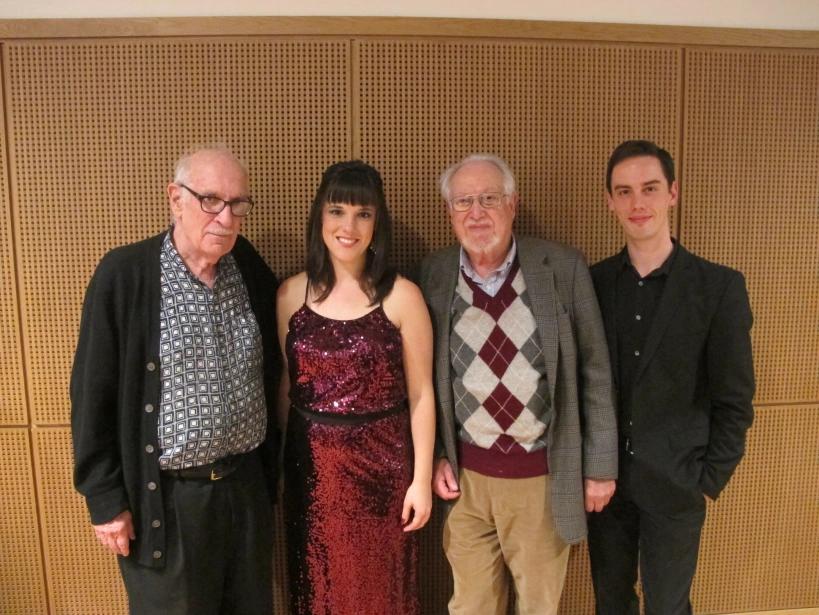
Here’s a picture from Mary’s concert. (l to r: George Crumb, Mary Mackenzie, Richard Wernick, and Eric Sedgwick)

IMG_3548

___________________________

* Not only was I there, but this was the occasion for one of those only-in-NYC moments: I got in the elevator to go find Jan and the composers whose songs she had premiered that night. In the elevator with me were Teresa Sterne (the force behind Nonesuch records in those days, including Jan’s unsurpassed recording of Ancient Voices) and Issac Stern. Ms. Sterne asked Mr. Stern the following question: “Is it true that you once received a review that said, ‘He left no tone un-Sterned’?” The answer was yes.

“Sketchbook” and “Holy the Firm” pictures

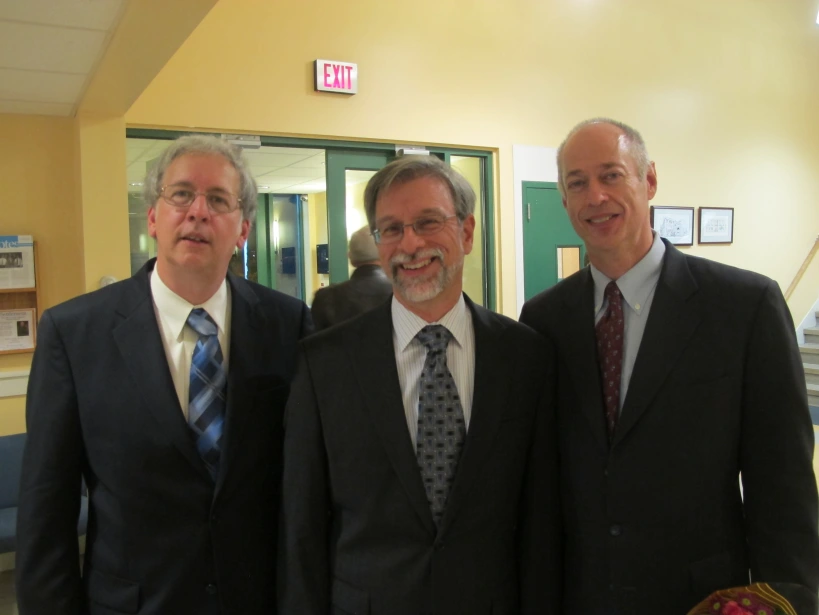
Here I am with Charlie Abramovic and Jeffrey Khaner after the concert at Settlement Music School here in Philadelphia where they premiered my new set of pieces for flute and piano (that’s Charlie on the left)

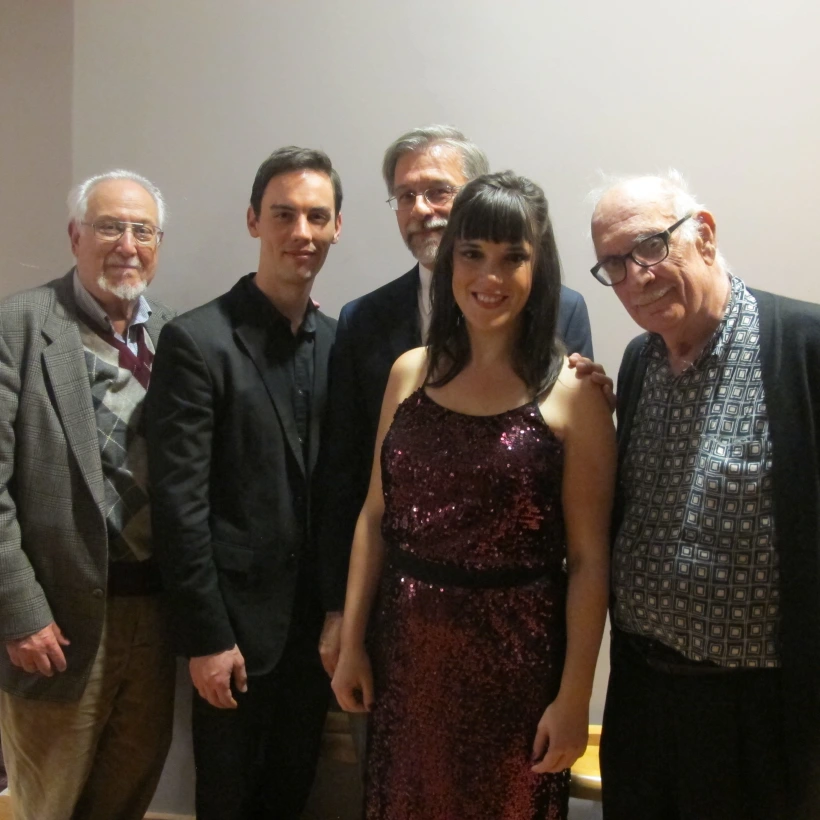
IMG_3544And a shot from tonight’s concert by Mary Mackenzie and Eric Sedgwick; from left Richard Wernick, Eric, myself, Mary, and George Crumb:

IMG_3551

a few more pictures yet to come, plus some comments on the concerts - brilliant performances both nights!

Mary Mackenzie at Penn

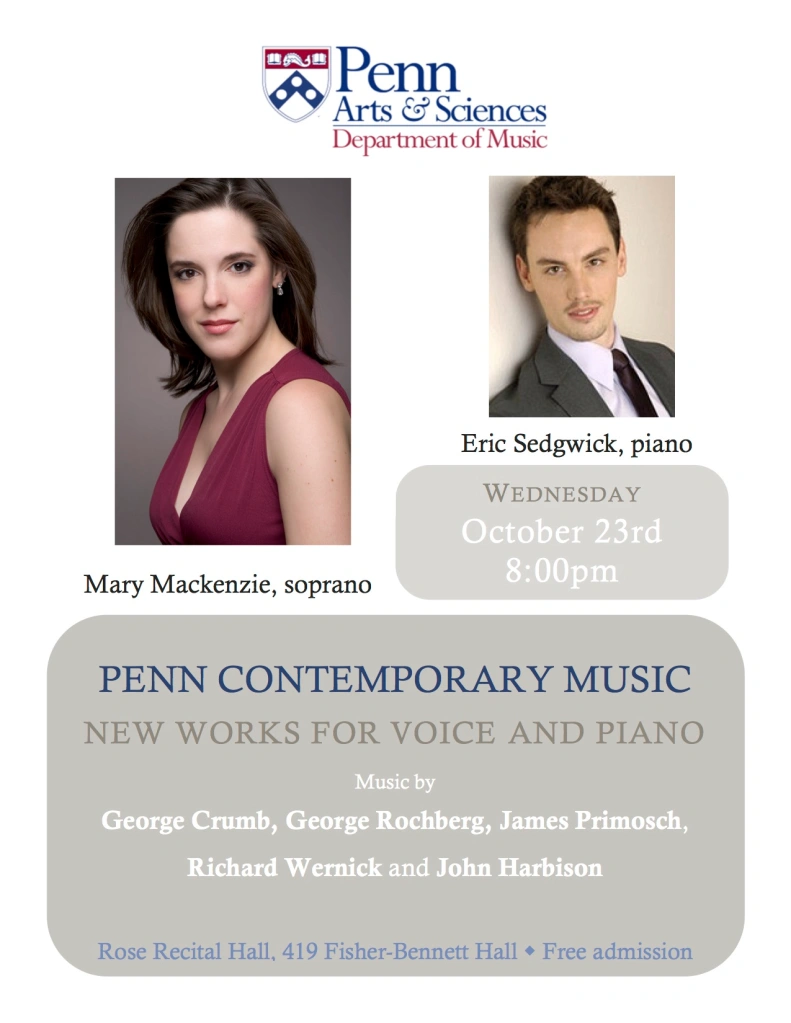
PCM poster 10.23.13Here’s the poster for next week’s concert by Mary Mackenzie and Eric Sedgwick at Penn. New works is a bit of a misnomer; in fact, all of the pieces are from the 20th century, not the 21st. But they are certainly contemporary in that all but one of the composers is still living, and George Rochberg only died a few years ago. Here is the complete program:

GEORGE CRUMB                Three Early Songs (1946)

(b. 1929)
I. Night
II. Let It Be Forgotten
III. Wind Elegy

GEORGE ROCHBERG         Eleven Songs (1969)

(1918-2005)
I. Sunrise, a morning sound
II. We are like the mayflies
III. I am baffled by this wall
IV. Spectral butterfly
V. All my life
VI. Le Sacre du Printemps
VII. Black tulips
VIII. Nightbird berates
IX. So late!
X. Angel’s wings (Ballad)
XI. How to explain (Ballad)

JOHN HARBISON                Simple Daylight (1988)

(b. 1938)
I. Japan
II. Simple Daylight
III. Somewhere a Seed
IV. Your Name
V. The Wild Irises
VI. Odor

- intermission -

RICHARD WERNICK          Moonsongs from the Japanese (1969)

(b. 1934)
I. Mikazuki wa…
II. Tsuki ni e wo…
III. Tsuki-wo matsumi…
IV. Tsuki ichi-rin…

GEORGE CRUMB                The Sleeper (1984)

JAMES PRIMOSCH             Holy the Firm (1999)

(b. 1956)
I. ‘…that passeth all understanding’
II. Every Day is a God
III. The Ladder of Divine Ascent
IV. Cinder
V. Deathbeds


While the compositions are not brand new, there is one completely new element involved. Dick Wernick’s Moonsongs from the Japanese is written for either three sopranos or a solo soprano with two pre-recorded sopranos. Since the sound quality of the tape from 45 years ago, prepared with Neva Pilgrim, the singer for whom the work was written, had deteriorated, Mary and I decided to re-make the recorded component. I am used to working with electronically generated sound, not a live recording of a human, so I have had to stretch my technique a bit in editing the material. Mary’s remarkable virtuosity made the recording sessions fairly straightforward. With Dick in attendance to guide us, we were able to do the job in relatively few takes. It will be a great pleasure to hear the piece for the first time in a new realization on this concert.

Here are some notes on the program:

When James Primosch invited me to present a solo recital at University of Pennsylvania, I immediately knew I wanted to create a program of all modern vocal music featuring some of the former and current composition faculty. It was very rewarding to explore each composer’s catalogue of work - there was so much to choose from and more than I could possibly program!

I connect equally with both music and words, and oftentimes, I feel a connection simply by looking at the score without knowing exactly what it sounds like.What I enjoy most about many of the pieces on this program is that they make powerful statements with very few words. As you listen tonight, I think you will discover that the music in each piece “illustrates” the poetry in a unique way. I prefer the word illustrate to painting - word painting is heard more often - because it brings to mind an artist making very small and detailed strokes, and the art grows out of the words.

I want to thank University of Pennsylvania for having me, and James Primosch and Richard Wernick for assisting with recording the soprano parts for Moonsongs From the Japanese.

-Mary Mackenzie


The Three Early Songs are jewels written in 1947 when the composer was 17 years old, and represent his first vocal writing. There were seven songs composed during this period, just after George graduated from high school, and he feels that these were “probably the best of them.” George didn’t really know the vocal idiom at this time, so they are not operatic but folk, in essence. As early works, they pay homage to Rachmaninoff, and although they are not representative of Crumb’ more mature style, they are “of some interest.”

- Barbara Ann Martin


When he died in November 1964 at the age of twenty, my son Paul left about 150 poems, most of them written in the years between the time he was fourteen and nineteen. Even while he was still writing I often thought of setting his work, but it was not until the late summer of 1968 when I wrote the Tableaux, based on fragments and images from his story “The Silver Talons of Piero Kostrov”,” that I was able to find a way to approach his uniquely individual language. From the very beginning Paul’s poems and stories had a surface sparseness which belied the richness and density of his images and emotional range. For me there is only one other poet in the English language whose early work has the same general characteristic: William Blake. But it was more likely Japanese and Chinese poetry and Eastern thought in which Paul was deeply immersed rather than Blake which influenced his attitude toward language, its texture and its capacity to imply more that it actually said. The surreal, fantasist worlds of Rimbaud and Redon also worked their special magic in his inner life.

These are “songs” then in the most traditional sense; and I have attempted to reveal through each setting the particular world of each poem, however brief some on them may be. The piano “accompanies” the voice at times; but it also behaves in other ways - commenting as the need arises or creating an environment in which the singer can project the verbal phrase and its imagery on her own. As always when dealing directly with someone else’s work, one hopes that he has not interfered with or obscured the essence of it, but rather projected it in new and clear light where its integrity remains intact.

- George Rochberg


It has been a source of satisfaction to me that the first performers and listeners for Simple Daylight have been especially struck by the poems, and by the strong musical responses elicited by the poems. I have been grateful for Michael Fried’s work in many ways, most obviously in my previous settings of his texts, in Three Harp Songs (1972) and in The Flower- Fed Buffaloes (1976). My ordering of his poems makes a sequence closer in tone to a Bach Cantata text than to a nineteenth-century song cycle, and evokes a kind of subcutaneous narrative very favorable for musical purposes, but no doubt unintended by the poet.

- John Harbison


Moonsongs from the Japanese was commissioned by Neva Pilgrim, for whom I had written my Haiku of Basho, and composed in late 1968-1969.  Hearing the piece now is much like looking back on a younger cousin. The piece is dedicated to Neva Pilgrim and the Apollo Moon Project, and I recall my wife and I rousting our kids out of bed to watch Neil Armstrong land on the moon. The original pre-recorded tracks were done on 15 ips reel-to-reel tape, pre-Dolby, and over the span of 45 years became totally degraded. I am grateful to Mary Mackenzie for having made the new ones in a digital format that might end up having a longer life.

The piece is made up of four very brief Japanese poems (not quite haiku), set to four equally short musical settings. The periods of the four poets range from the 15th to the 20th centuries. The musical style is far different from the one I use today, although I can detect the roots of what I now do. Unlike many other composers I never made a quantum leap from one style to another, and it pleases me to look back on the gradual change.

I have attached to the score a wise line from a wise playwright, Brendan Behan—“Don’t muck about with the moon”.

- Richard Wernick


For the text of this little song [The Sleeper] I have excerpted only a very few lines from Edgar Allen Poe’s poem. Admittedly the sense is thereby considerably altered (Poe’s poem is somewhat lugubrious in its total effect), but I do feel that there is such a thing as “composer’s license.” Besides, I was specifically asked for a short song!

The sparse, tenuous textures and extremely soft dynamic of The Sleeper will project a kind of “minimalissimo” character. I have used a range of timbral devices in the piano part to suggest that transcendental feeling which Poe’s eerie images of nature invoke  — rustling glissandos on the strings of the instrument, delicate muted effects, and bell-like harmonics (which ring in the midnight hour in the first bars of the song).

The vocal part, which is quite simple in style and based entirely on a few tiny melodic cells, requires great sensitivity to nuances of pitch and timbre. I have endeavored to compress an intense and even expansive expressivity into a very small frame, which is, I suppose, what writing a little song is all about.

- George Crumb


The little anthology of texts dealing with praise and mystery that I have assembled for Holy the Firm draws upon writings of three twentieth-century American women and a monk of the seventh century Sinai desert. It may be helpful to know that the fifth text is excerpted form a found poem based upon phrases culled from the Dictionary of Last Words edited by Edward S. Le Comte. The wide-ranging affects of the texts called forth a similar range of musical languages but there are many recurrences, both musical and textual, that bind the songs together.

The cycle’s title is borrowed from that of a book by Annie Dillard that also provided the words for the second song.  In that book, Dillard writes: “Esoteric Christianity, I read, posits a substance. It is created substance, lower than metals and minerals on a ‘spiritual scale’, and lower than salts and earths, occurring beneath salts and earths in the waxy deepness of planets, but never on the surface of planets where men could discern it; and it is in touch with the Absolute at base. In touch with the Absolute! At base. The name of this substance is: Holy the Firm.”

- James Primosch


More about this concert next week.

Almost a Festival

If one performance is a concert, do two performances in quick succession in the same town constitute a festival? I don’t know about that, but there is a happy coincidence next week when my Philadelphia Chamber Music Society commission A Flutist’s Sketchbook will have its premiere on Tuesday, Oct. 22, and the next night Holy the Firm will be performed by soprano Mary Mackenzie and pianist Eric Sedgwick. Here are the details:

October 22, 2013 at 8:00 pm:
A Flutist’s Sketchbook (premiere)
Jeffrey Khaner, flute
Charles Abramovic, piano
Philadelphia Chamber Music Society
Settlement Music School
Queen Street Branch
Philadelphia, PA

October 23, 2013 at 8:00 pm
Holy the Firm
Mary Mackenzie, soprano
Eric Sedgwick, piano
Penn Contemporary Music
Rose Recital Hall (in Fisher-Bennett Hall)
34th and Walnut Streets
University of Pennsylvania
Philadelphia, PA

Jeffrey Khaner is the principal flute of the Philadelphia Orchestra; Charles Abramovic is a renowned chamber music partner, working with artists such as Midori and Sarah Chang as well as being a stalwart advocate for new music. I am greatly honored to have them perform my music. The commission was for a work accessible to players of modest attainments while remaining satisfying for professionals. I was uncertain as to exactly where to target the piece, and therefore this is a set of “13 easy and not so easy pieces” as the work’s subtitle describes it. Given the simplicity of some of the music, it strikes me that having Jeff and Charlie play the Sketchbook is like using nuclear weapons to kill a mosquito. Still, it will be a thrill to hear their formidable gifts put at the service of this modest music.

In contrast, Holy the Firm is rather immodest music. Written as it was for Dawn Upshaw and Gilbert Kalish, this time I tried to make a big statement commensurate with the capabilities of those artists. Dawn specifically wanted a cycle, not an individual song, so H the F is a set of five movements, shaped by an expressive arc that binds the songs together quite literally - the songs follow each other with little or no pause (although individual songs can be extracted and performed separately, as has happened on many occasions). There are motivic recurrences that also tie the pieces together, with material from the first three songs (settings of Denise Levertov, Annie Dillard and the 7th century monk John Climacus) recurring in the finale, a kind of mad scene setting a found poem also by Annie Dillard. The expressive fulcrum of the piece is based on Susan Stewart’s Cinder, the first of 10 poems of Susan’s I have set, (with more settings to come). Here is Susan’s haunting text:

We need fire to make
the tongs and tongs to hold
us from the flame; we needed
ash to clean the cloth
and cloth to clean the ash’s
stain; we needed stars
to find our way, to make
the light that blurred the stars;
we needed death to mark
an end, an end that time
in time, could mend.
Born in love, the consequence –
born of love, the need.
Tell me, ravaged singer,
how the cinder bears the seed.

Showing Up

Do the Math affirms the old principal that a goodly portion of life is about showing up. Here are a few things at which you may show up:

- I’ll be introducing a talk by George Lewis at my day job tomorrow, Sept. 12, 5:15 in the Music Building on the Penn campus. It feels a little like I am introducing a panel discussion - we will be hearing from a trombonist of historic important with a huge discography; a pioneer of electronic music, particularly in live and improvised contexts; and a musicologist who wrote an important history of the AACM.

Here is George Lewis speaking prior to a program of his music at Columbia’s Miller Theatre in 2012:

- the first of two all-Harbison Songfusion programs is this Friday in NYC. My friend Mary Mackenzie will be doing Simple Daylight, John’s emotionally devastating and impeccably crafted song cycle on Michael Fried texts, written for and recorded by Dawn Upshaw. The program includes instrumental works as well as vocal; the players include Ben Fingland, who gave that fine performance of my clarinet concerto last season.

- Judith Gordon, who premiered my piano consortium commission last spring, will take the piece out for another spin later this month. She will include Pure Contraption, Absolute Gift on a Sage Chamber Music Society concert, Sunday, September 29 at 4. The program is free, and will take place at Sweeney Concert Hall on the Smith College campus. More soon on performances of my music this coming season - for now click on the “performances” tab above.