Upcoming in Philly and NYC

- March 18 - soprano Mary MacKenzie (of SongFusion) performs with Shuffle Concert this Friday, March 18 at Baruch College. It’s a nice idea - the audience picks the program on the spot!

-March 19 and 20 - Orchestra 2001 plays Hindemith, Berio and Roberto Sierra. Julianne Baird, soprano; Marcantonio Barone, piano, Lori Barnett, cello are featured. The performance on the 19th is at the Trinity Center in Center City, Philadelphia, on the 20th at Swarthmore College.

- March 22 - the Philadelphia chapter of the American Composers Forum presents a webcast interview with George Crumb at 7 PM. Audio trailer here.

- March 29 - Penn Contemporary Music presents violinist Maria Bachman and pianist Jon Klibonoff at Penn’s Amado Recital Hall in Irvine Auditorium, 34th and Spruce Street. Program includes Glass: Sonata No. 1; Paul Moravec: Three Pieces; George Rochberg: Sonata; and the first performance of a new work by Penn faculty composer Jay Reise, The Flight of the Red Sea Swallow. The Glass and Moravec works are Philadelphia premieres. The late George Rochberg was, of course, a long-time Penn faculty member, and he wrote his sonata for Bachman.

- April 12 - looking a little ahead, the Curtis Symphony Orchestra will perform Messiaen’s Turangalila Symphony at the Kimmel Center, Christoph Eschenbach conducting, with Di Wu, piano and Thomas Bloch, ondes Martenot.

Crumb’s Songbooks in LA, NYC, Ojai

Delia Casadei has a fine piece on George Crumb in the LA Times. It is especially nice to see the Songbooks getting such high profile performances, particularly by Upshaw and Hampson. (Nothing against Tony Arnold, who is quite fabulous and deserves the kind of recognition Upshaw and Hampson have achieved.) Dawn has narrowed down her list of composers a bit in recent years (as I know all too well), good to see George is still on that list. And Hampson’s advocacy of American music has tended toward more conservative composers.

It will be interesting to see what Sellars does in staging the pieces. A performance of one of these Songbooks involves a huge array of percussion that is already quite arresting, visually; I don’t know the Ojai stage, but I wonder how much room there will be - literally and psychically - for a staging.

I previously posted about George’s American Songbooks here. (photo: Peggy Peterson/Bridge Records)

Penn Troika

Go here for Kyle Gann’s post on Rochberg’s Serenata d’Estate. He talks about the similarity between certain moments in the Serenata and the work of George Crumb - so I had to post a lengthy comment there about the whole Penn Troika phenomenon. Kyle makes an intriguing connection between Rochberg and Feldman, of all people - funny to think of their work intersecting. Maybe the stasis of Varese is a common thread, with Varesian dynamics turned upside down in Feldman, of course. Earlier I wrote about Rochberg here, and here.

Crumb’s American Songbooks

George Crumb is a quintessentially American composer - to my mind, ranking with Ives and Copland. Wildly popular in the 1970’s, Crumb’s stock fell a bit in the 1980’s, though I think his popularity overseas did not wane as much as here in the states. Crumb has experienced a late-in-life creative blossoming, in some ways comparable to that of Elliott Carter, two decades older than Crumb. Carter was extraordinarily productive in his 90s, and during the same period, Crumb was similarly productive in his 70s, finding in American folksong a rich compositional resource. The result has been a series of American Songbooks, now grown to six substantial sets. In these, Crumb has arranged folksongs, spirituals, and other traditional tunes, either for solo voice, or two singers, accompanied by percussion quartet and piano. The medium is perfect for Crumb, with his exquisite ear for instrumental color and preference for long ringing sounds. Each set uses an extraordinarily large complement of instruments, including various non-western ones. (The works would surely be more widely known if the instrumental resources required were not so great.) The piano, as the composer has remarked, serves as a bass for the percussion ensemble which it would otherwise lack.

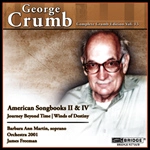
The pieces have been written with Philadelphia’s Orchestra 2001 in mind (see a relevant video clip at their website), and the group’s performances, led by its artistic director James Freeman, are exemplary. The first four of the Songbooks have been recorded for Bridge Records, with Barbara Ann Martin, and the composer’s own daughter Ann Crumb as the superb soloists. (Find Songbooks II and IV on disc here; Books I and III here.) The Bridge releases are part of a their “Complete Crumb Edition”, an admirable commitment to documenting the work of a true American treasure.

Composition Inflation

Bruce Brubaker has posted recently on the topic of repertoire inflation - the tendency of young pianists to take on gargantuan pianistic challenges at an unnaturally young age - high school students playing the Liszt Sonata or Gaspard. I share his concern - there is something absurd about the first Beethoven sonata you learn being Op. 111.

I fear that something similar that can happen in composition: the young composer who tries to write a  40 minute cantata when it might be a better idea to craft a well-made 10-minute song tryptych. Not that students shouldn’t set the bar high - it’s important to challenge oneself. After all, the reverse can also be a problem, the student who is too easily satisfied with presenting a few sparse ideas without really digging in and exploring the material.  (This kind of piece usually comes with cute movement titles.) As always, the challenge is to come down in “the place just right”.

Composition inflation can affect composers later on in their career, resulting in pieces that strive for extreme emotional content, sometimes with good results, sometimes not.

40 or 50 years ago, undoubtedly in the shadow of The Bomb, there developed a genre of apocalyptic pieces: Don Erb’s The Seventh Trumpet; Crumb’s Star-Child (complete with an army of tom-toms depicting the Four Horsemen of the Apocalypse) and Black Angels; Richard Wernick’s Visions of Terror and Wonder; Rochberg’s Apocalyptica; the Ligeti Requiem; Karel Husa’s Music for Prague might fit in here. Penderecki’s Threnody for the Victims of Hiroshima is perhaps an early example, with Messaien’s Quartet for the End of Time being the progenitor a generation earlier, and with works by Berlioz, Verdi and Mahler in the background. Christopher Rouse is the prime exponent currently, and handles it masterfully. Don’t get me wrong, I love many of these pieces. It is just that the apocalyptic genre is not for every composer, and shouldn’t be for every piece.

I first started thinking about this when I heard John Harbison’s bass concerto a few years ago. I was struck by how the piece was content to be what it was - that it didn’t have to carry stupendous emotional weight or an apocalyptic scenario. I don’t mean it was dry - the piece is elegant, imaginative, and expressive without sentimentality. Now, in part this has to be ascribed to the medium - it is hard to imagine a bombastic double bass concerto. But it also can be traced to John’s willingness to write something that didn’t have to compositionally or emotionally show off (the soloist does get to shine, of course.) It is a little easier to do this when you have more opportunities to write for orchestra, since there is less pressure to make a single piece be everything and do everything.

I hope my own music has enough expressive range to encompass the explosive and the playful, the intimate and the epic - but not necessarily all of those in every piece.

Rochberg’s lines and spaces

Five Lines, Four Spaces: The World of My Music by George Rochberg is disappointing for those of us who were hoping for a more comprehensive memoir. There are only glimpses of a personal narrative here. I would have liked to hear more about Rochberg’s family of origin, his own family, his work at Theodore Presser Co. and at the University of Pennsylvania.  But George chose to make the book principally about his music. (I say “George chose”, but my understanding is that the published book is only a fraction of a much longer manuscript - hence the somewhat patchwork form of the book. You’ll have to visit the Sacher Foundation to read the whole thing.) The book is mostly about the origins of selected pieces of George’s, combined with praise for the best performers of those pieces, and warmed-over polemic aganist modernism in general and serialism in particular. Actually, the warming-over is more like boiling over. Rochberg in his last years remained intensely angry about what he saw as the evils of serial music. This is mostly old news, though the book includes a new attack on Joseph Straus for his article demonstrating how serial composers didn’t actually dominate the musical culture the way people think they did, Rochberg saying this is an attempt to “de-Stalinize” the era.

George’s voice does come through in the book, and not always in a flattering way. Throughout, the tone is pretentious - all rehearsals are exhaustive, all his pieces seem to be of the utmost expressive intensity at all times - as though he needs to reassure himself of his work’s importance. Although he is nice about some performers of his music, sometimes to the point of overpraising them, there is also a striking and sad lack of generosity toward his colleagues. George has nothing to say about those who worked with him at Theodore Presser Co., and nothing about his composer colleagues at Penn, except some shabby comments about George Crumb’s music. (The one mention of a Penn colleague of any kind is of how medievalist Norman Smith confirmed that the Latin for the title of Contra Mortem et Tempus was correct.) Relatively few composer colleagues are mentioned in the book and George almost never acknowledges owing any of them any musical debt. He is, in general, only influenced by dead composers. He takes pains to make clear that he was writing 12-tone music before he met Dallapiccola. He does show some collegiality when he expresses his gratitude to Ulysses Kay for helping proof the parts to his early Night Music, or to William Schuman for his positive reaction to Rochberg’s Sonata-Fantasia.  And he does acknowledge a few contemporary works. There are passing references to the Barber Piano Sonata - as a piece in the background of the Sonata-Fantasia - and to one of Ligeti’s woodwind quintets - mentioned in a discussion of Rochberg’s own quintet. But he seems to work in a kind of isolation. You wouldn’t know from this book that any other composer of that period was rejecting aspects of modernism as was Rochberg.

The consequence of this isolation can be some curious assertions. Like the self-deception I posted about earlier, this example has to do with Crumb. Rochberg speaks of having “invented” the piano harmonics he employed in his chamber piece Contra Mortem et Tempus. These are not the sympathetic harmonics that we know from Schoenberg’s and Berg’s piano writing, involving silently depressed keys. Rather, the ones George used require touching the piano string at the appropriate node, just like playing harmonics on a violin or guitar. I don’t have the scores at hand, but I am fairly certain George Crumb used such harmonics in his Five Pieces for Piano and Night Music I, of 1962 and 1963 respectively - before Rochberg’s 1964 Contra. Now, Crumb did not join the Penn faculty until 1965, but it still seems odd that Rochberg was not aware of his younger colleague’s use of this technique - and odd that years later he still didn’t know Crumb’s use of harmonics predated his own.

And yet, for those of us who love the Serenata d’estate, the Second Symphony, the Third Quartet, Contra Mortem et Tempus, the Sonata-Fantasia, and more; for those of us who are grateful for the insights gained by studying with George; for those of us who admire the courage and passion with which George pursued his musical visions, the book is fascinating, if sometimes sad reading.

How we fool ourselves

“The determining impulse for the Third Quartet was a fall 1971 concert that took place at the University of Pennsylvania… [that included] George Crumb’s Black Angels… This concert and performance of Crumb’s work, which I’d not heard before, helped produce the seed for my Third Quartet. I remember with absolute clarity that the moment Black Angels ended and I was leaving the hall I said to myself, “Now I know what not to do.”

-from, Five Lines, Four Spaces: The World of My Music by George Rochberg

And so George went home and wrote his important and beautiful Third String Quartet: a piece that juxtaposes tonal and modernist musics; that layers tonal music with non-tonal figuration; that features a rapturous major key adagio; and that opens with a fortissimo statement in rhythmic unison of a repeated tritone-laden motto that returns later in the piece - all traits that Rochberg’s Third Quartet shares with Crumb’s Black Angels.