Scenes from Whaling Trip

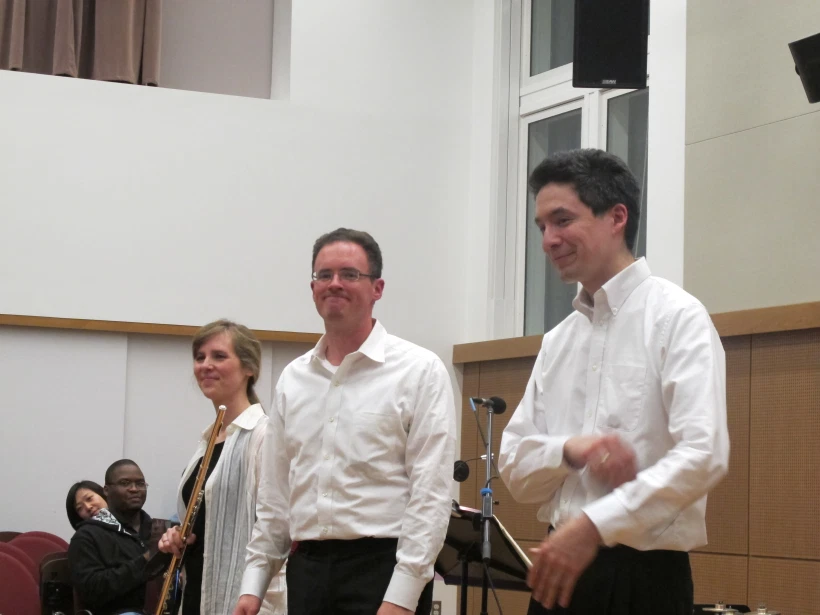
Here are a few pictures from Wednesday night’s “Voice of the Wail!” concert at Penn. There were some fine performances by the Daedalus Quartet, pianist Greg DeTurck, and College House Music Fellows Michelle Kelly, Matt Bengston, and Tom Kraines. And who could resist the masks for Crumb’s Voice of the Whale? ( L to R: Michelle Kelly, Matt Bengston and Tom Kraines,)

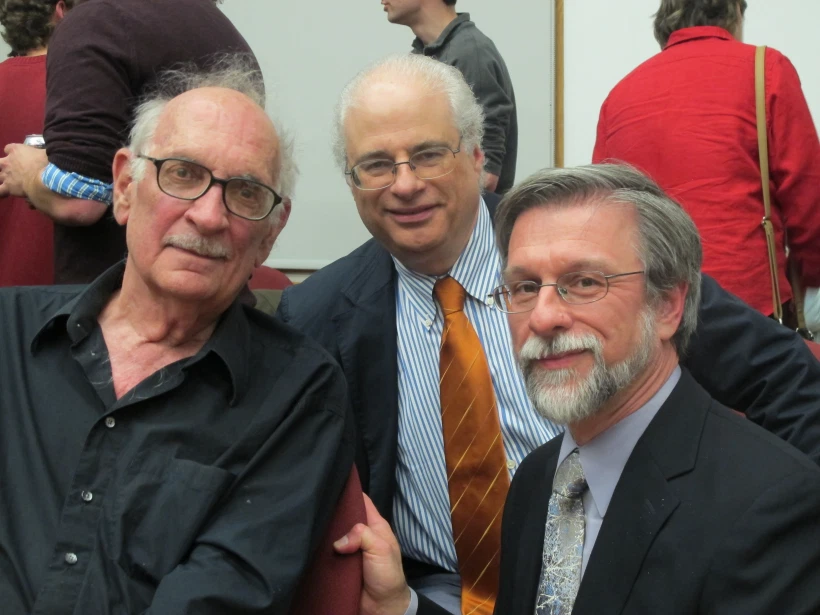
The surviving members of the so-called Penn Troika (Penn composition faculty members Rochberg, Wernick, and Crumb) were present, along with the current composition faculty and some alums. Here are (L to R) George Crumb, Jay Reise and myself:

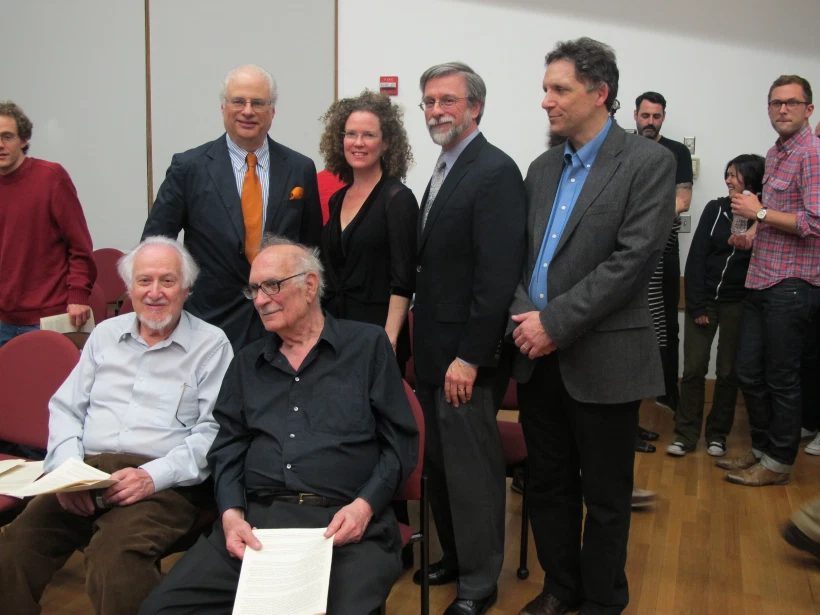
and a whole pod of whales, I mean group of Penn composers (seated, l to r: retired faculty members Richard Wernick, George Crumb; standing: current faculty members Jay Reise, Anna Weesner, myself, Penn alumnus Philip Maneval):

More about the concert here, here, here and here.

Sound as Four, Sound as One

Anna Weesner has sent along her program note for Sound as Four, Sound as One, the work that the Daedalus Quartet will perform as part of the Wail of the Voice concert next Wednesday:

In clear connection with the title, this quartet opens with the sound of all four players in unison, a sound that is then quickly juxtaposed with the sound of one voice alone.  A basic notion concerning the many and the one, or the one and the many, informs much of this piece.  This expressive notion probably has a few different points of origin for me.  For one, I have long loved the sound of strings playing in unison in the register represented by the lowest octave of the violin.  There is something about the less-is-more timbral mix that occurs when violins, viola and cello play together in this range that has always sounded potentially gutsy and sort of heart-rending at the same time.  There is also a textural concern that I think has to do with wanting to explore questions about the role, or the “sounding meaning”, so to speak, of melody.  In addition to playing in actual unison, the quartet often plays in rhythmic unison, which may set off as meaningful other textural situations, such as when there is clear melody and accompaniment, or when there is one voice alone.  I also hope that there will be a sense of space in play, so that the louds and softs in the music might translate somehow as being equally concerned with feelings of near and far.  I imagine, for example, someone who is far away calling out loudly in contrast to a softly murmuring crowd nearby.  Or perhaps it’s a single person murmuring nearby and a crowd far away, roaring.

We’ve got the program order figured out for the concert, here’s the lineup:

Anna Weesner: Sound as Four, Sound as One
Daedalus Quartet

James Primosch: Piano Variations
Gregory deTurck, piano

- intermission -

Jay Reise: Yellowstone Rhythms
Samuel Lorber (scroll down), saxophone; Matthew Bengston, piano

George Crumb: Vox Balenae (Voice of the Whale)
Michele Kelly, flute; Tom Kraines, cello; Matthew Bengston, piano

The time and place again: 8:00 pm, Wednesday, March 28, in Rose Recital Hall in Fisher-Bennett Hall on the University of Pennsylvania campus. Fisher-Bennett is at 34th and Walnut. There will be a pre-concert chat with the composers, moderated by Penn grad student Delia Casadei, at 7:00 pm. An article by Delia about George Crumb here. More on the concert here and here and in future posts.


Wail of the Voice

Lots of new music at Penn in coming weeks. Music by Penn faculty past and present will be heard on Wednesday, March 28, at a program playfully called “Wail of the Voice”, with reference to the Crumb work that will end the program, Voice of the Whale. There will be music by current faculty Anna Weesner and Jay Reise, as well as myself. The Daedalus Quartet will play Anna’s piece, Greg DeTurck will offer my Piano Variations, and there will be a piece for saxophone and piano by Jay. In addition to Greg and the Daedalus, Matt Bengtson (piano), Sam Lorber (saxophone), and Michele Kelly (flute) will also be heard. A pre-concert discussion will be at 7:00, concert at 8:00, all this in Rose Recital Hall at Fisher-Bennett Hall on the Penn campus.

One week later, April 4, same place, same time, the New York New Music Ensemble will appear. The program includes:

Rand Steigerelliott’s instruments (2010)
Eric ChasalowOn That Swirl of Ending Dust (2012) Written for NYNME
Yiorgos VassilandonakisQuatuor pour la fin d’une ère (2012)  Written for NYNME
Zhou Long Cloud Earth (2012) Written for NYNME

=======================================

Hear whales wailing here.

Voices from the Heartland

George Crumb says he has now finished his American Songbook project, with the final installment premiered last night in Philadelphia by Orchestra 2001 with James Freeman conducting. This has been a huge undertaking: seven big cycles of folk song settings, all for solo voice or two singers, accompanied by percussion quartet plus amplified piano. This last set, called Voices from the Heartland, includes settings of “Softly and Tenderly” “Lord, Let Me Fly!”, and “Beulah Land”, among others, as well as a couple of American Indian chants. There is a delightfully Ivesian treatment of “Come All Ye Fair and Tender Maidens” combined with “On Top Of Old Smokey” - the two songs are sung simultaneously in different keys. In a sense, the pieces break no new ground for Crumb - he has his language  - but within that language they are unfailingly imaginative, varied, and beautiful. The performance was very fine, with George’s daughter Ann and baritone Patrick Mason as soloists. These singers, along with the instrumentalists of Orchestra 2001, are so experienced in performing Crumb’s music that the special demands he places on them - whispered vocal effects, or myriad non-Western percussion instruments - pose no problems. It is uncommon to hear players, for example, consistently command the extremely soft dynamics that George often requests.

I do wish the voices had been amplified more subtly - not just more softly, but not as closely miked. I feel there must be a way to use the amplification to support the voices and help them compete with the loudest percussion passages while still making it feel like the voices and the percussion are in the same acoustical space. In contrast, the amplification of the piano made some of its more delicate effects audible while keeping the instrument integrated with the non-amplified percussion. You were constantly aware of the voices being amplified - it shouldn’t draw attention to itself in this way.

The amplification was also a bit too loud for the Boulez Anthèmes 2 on the first half of the concert, in a virtuosic performance by Gloria Justen, with Peter Price assisting at the laptop.  As for the piece itself, it is a pleasant 8 minute demonstration of how a computer can process live violin sound. Unfortunately, the piece went on for 3 times that length. While the sounds were attractive, Boulez just presents them, never shaping them into a narrative. Not that every piece has to have a linear narrative; a succession (rather than a progression) of contrasting gestures can work, but if you are going to have a piece that long, you would need less repetition of gestures, or at least some genuinely extended phrases, rather than short phrases going on at length. A comparison with the Crumb is instructive: both pieces rely on an unusual sound palette, but the carefully shaped forms and the sensitive attention to timing in George’s music makes for a vastly more successful piece.

The concert began with a short piece by Louis Andriessen, a setting of a letter he received from mezzo Cathy Berberian, the spouse of composer Luciano Berio. In the letter she speaks of how Stravinsky re-shaped what became his Elegy for J. F. K. for her. The piece is straightforward, light in manner, with a hint of elegiaic tone, for it memorializes an artist who died too young. Ann Crumb served the piece well with her charismatic theatrical flair.

Here I am with George after the performance:


More about George and the Songbooks, here, here, and here.

Tuesday Night Miscellany

- Stephen Hough has a remarkably poetic post on Anglican Evensong.

- Matthew Guerrieri on the Harbison 6th.

- George Crumb premiere coming up this weekend in Philly with Orchestra 2001. David Patrick Stearns has a preview.

- Prism collaborates with Music from China in NYC February 3 and in Philly Feb. 4. Details here.

Here’s a video prepared by the Chamber Music Society of Lincoln Center with Gil Kalish on Crumb:

Tony Arnold on Carter

Soprano Tony Arnold has an exceptionally thoughtful piece on Elliott Carter’s vocal music at New Music Box. Her main points - a questioning of the real meaning of “idiomatic” writing; and an invitation to consider the role of timbre in performing this music - are important both for composers and performers.

I couldn’t find anything on YouTube with Tony singing Carter; instead, here she is with Crumb’s first book of Madrigals:

Upcoming in Philly, Boston, Phoenix, and NYC

- New music choir The Crossing offers three performances of Kile Smith’s Vespers, collaborating with Piffaro, The Renaissance Band. I don’t know a better contemporary piece for old instruments - for that alone the work is a remarkable achievement. But instrumentation aside, this is exceptionally beautiful music. January 7 and 8 in Philadelphia, January 9 in New York, details here.

- Eric Chasalow’s new horn concerto will be heard at the Southwest Horn Conference in Phoenix on January 14, and in Boston at a BMOP concert, January 27. Eric is perhaps best known as a master of the electronic medium, but his acoustic music is just as superb.

- There will be an evening of music by Hayes Biggs at Manhattan School, January 15. I earlier wrote about the Avalon Quartet’s recording of Hayes’s touching O Sapientia/Steal Away here. Update: more info about the concert here. Susan Narucki and Christopher Oldfather will offer a new song cycle.

- The seventh and final volume of George Crumb’s American Songbook will be premiered by Orchestra 2001 on January 28 and 29 in Philadelphia.

Recent listening - quick takes

A few items, new and old, that I have enjoyed recently:

Thomas Adès: Tevot, Violin Concerto, Three Studies from Couperin, Dances from Powder Her Face. The first two pieces are major statements. Tevot - the name means “ark” or a musical measure - is a big single movement orchestra piece, thickly layered, recalling Ligeti in its density; the concerto is of necessity more lightly scored. Both pieces share some of the same interests in repeated, layered cycles - both have memorable slowly descending quasi-tonal chord progressions - not unlike the infinitely unfolding slow music in Adès’ Asyla. The “non-tonal” or “quasi-tonal” successions of tonal chords recall some of the modal effects of Vaughan Williams, of all people, as well as some of John Adams’s preferred harmonies. Probably the neo-Riemannian harmonic analysis that has been in vogue for a bit (identifying compositional strategies that change just a note or two when moving from chord to chord) would work well on these passages in Adès.

Miles Davis: “Four” and More. Classic live material from 1964, with George Coleman, Herbie Hancock, Ron Carter and Tony Williams (only 18 at the time). Davis and his colleagues were done a disservice by whoever compiled so many insanely fast pieces into a single album. It is pretty hard to take straight through, but in smaller doses it is astonishing. I especially liked the energetic and constantly varied work of Williams. He is a very active player, but there is an airborne quality to the sound he gets from his set that keeps his playing from being overwhelming.

George Crumb: The Ghosts of the Alhambra, Voices From a Forgotten World. Volume 15 in the Complete Crumb Edition being issued by Bridge Records offers two vocal pieces. Alhambra returns to Crumb’s beloved Lorca, in settings for baritone, guitar and percussion, while Forgotten World is the fifth in Crumb’s cycle of American Songbooks, arrangements of traditional American tunes for voice (in this case, baritone Patrick Mason and mezzo Jamie Van Eyck) and a percussion orchestra manned by four players, plus amplified piano. Members of Orchestra 2001, led by James Freeman, are old hands at Crumb’s music, and the performances are superb. In the last stanza of the last song, “The Demon Lover”, the mezzo sings “And what hills, what hills are those, my love, Those hills so dark and low? and the baritone replies, “Those are the hills of Hell my love, Where you and I must go.” Crumb’s setting is appropriately disturbing and profoundly creepy.

Coming Attractions - 2011-2012

- Go here for a press release on the upcoming Miller Theater season, including a massive James Dillon 3-night extravaganza and Composer Portraits including John Zorn and George Lewis.

- the Orchestra 2001 website lists three programs for next year, with Boulez, Adams, Pärt, Andriessen, and a Crumb premiere - the seventh book in his remarkable American Songbook series.

- CityMusic Cleveland offers 24 free concerts next season.

- Network for New Music’s focus is on what they are calling Word Music, with big pieces by Lewis Spratlan and Matthew Greenbaum, and collaborations including one with The Crossing.

Sellars does Crumb

Peter Sellars is staging a performance of George Crumb’s Winds of Destiny at Ojai. In this feature on the NPR website, Crumb says how Dawn Upshaw’s performance of “When Johnny Comes Marching Home” helped inspire his own setting of the piece in this cycle. I was at her performance of that tune, because it was part of her Carnegie Hall debut program in which she did my Denise Levertov setting Bedtime as part of a group of songs by composers roughly of her own generation. It was an amazing program. After that group, she did a staged version of Crumb’s Ancient Voices of Children, then a set of folks songs with Bill Crofut. In the Crumb staging, prepared with Bill T. Jones, Upshaw became what was undoubtedly the first soprano making her Carnegie recital debut to spend time during the performance laying flat on the floor of the stage. More on Crumb here and here. Audio and video from the Ojai site here.