It was as if she were saying to him: All that’s happened is inconsequential; it cannot hurt us anymore; there’s only music, which lives within us and beyond us, needing us to express it, but capable of surviving forever between expressions.
-from “Europe Central” by William T. Vollman
Month: February 2011
New Music at Philadelphia Orchestra 2011-2012
The season announcement for the Philadelphia Orchestra has come out. There are plenty of appealing concerts, but it is rather slim pickings for new music. From what I can see, next season includes:
-Yannick Nézet-Séguin conducting the Higdon Concerto for Orchestra, Dec. 8 through 11. This is the piece that helped rocket Jennifer to fame thanks not only to its intrinsic qualities, but to the fact that it was premiered by the Philadelphia the week what was then called the American Symphony Orchestra League was having its convention in Philadelphia.
-Michael Torke’s Ash, with David Zinman conducting January 6 - 8. I think this is the first time Michael’s music is being played by the Orchestra.
-Esa-Pekka Salonen presenting his own Violin Concerto, with Leila Josefowicz soloist, March 29-31.
And that is about it as far as living composers. This is another transitional year for the orchestra, of course, and I would guess there will be a little more new music as Yannick settles in - I certainly hope so.
Mahler 7 at the Kimmel Center
 I just got in from hearing the London Symphony and Gergiev do Mahler 7. Received wisdom says that this is a problematic piece, with the outer movements not seeming to be from the same piece as the inner movements, especially the two Nachtmusiken; the finale also comes in for criticism as being strangely banal. I never found the work to be a problem, but I have an odd relationship with the piece - it was the first Mahler I ever heard, when I brought home an LP copy of Lenny and the NY Phil from the public library back in my home town. I was caught right in the first few bars, and have had a special affection for the piece ever since. I had the privilege of hearing Bernstein conduct the piece in the 80s, and it was the way he could capture the nuances of tempo that I missed tonight. Gergiev simply played the piece too darn fast. The first movement was the best, but the 2nd, 4th and 5th were all rushed. Rehearsal 72 in the second movement is marked molto moderato in 4/4 but tonight it was played as though in 2/2, with a moderately moving half note. It was impossible to articulate the staccato triplet offbeats in the horns at 3 before 79, and so the charming waltz-like effect was lost.
Maybe it was just the Lenny charisma, but somehow he made the finale work - it was ironic in its juxtapositions. There is that startling moment when a soft a-flat chord is revealed when a tutti C major chord cuts off, and there are similarly abrupt inflections of tempo - I count 72 indications of tempo changes and nuances in the score of the finale. And yet the piece is sincere as well - the bell-ringing passage near the end is genuinely joyful. Tonight’s rushed performance seemed to bring out the banalities, and lacked the sense of irony that Bernstein achieved. At moments it seemed like Mahler had been influenced by Shostakovich, which is not a good thing, in my book.
While the conducting was dismaying, the playing was magnificent - rich in dynamic contrasts, virtuosic in the demanding solos (the horn playing was memorable), precise and clear, but warm in ensemble sound. The end of the fourth movement was magical, as it should be - all credit to Mahler and the players rather than the conductor.
It is not a new post, but via Classical Convert - choose your own Mahler Symphony cycle.
Presidential singing
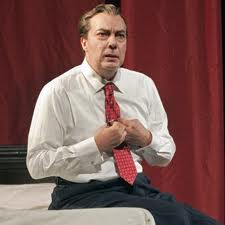 My friend Paul Moravec let me know about a series of posts on NPR’s Deceptive Cadence blog - a set of pieces in which various composers have put to music brief quotes from various American presidents. Paul did Eisenhower; Nico Muhly did Andrew Jackson, the late Milton Babbitt did Madison; there are pieces by Jake Heggie, Sam Adler and several more. (at left, a singing president - James Maddelena as the title character in Nixon in China.)
Steven Stucky Missing
What does it say about our musical culture that James Oestreich can write the following in a spring preview piece in the Times about a festival of visiting orchestras at Carnegie Hall:
Though top-rank orchestras are eligible, few American behemoths have yet shown interest. But the Montreal Symphony is here with Kent Nagano leading a program tracing the evolution of the symphony, from Gabrieli brass works and Bach sinfonias to Beethoven’s Fifth. Jaap van Zweden leads the Dallas Symphony in a work it commissioned for the Lyndon B. Johnson centenary in 2008, “August 4, 1964.”
The other orchestras for the inaugural season are the Albany Symphony (with an evening of reimagined spirituals), the Toledo Symphony, the Oregon Symphony, the St. Paul Chamber Orchestra and the Orpheus Chamber Orchestra of New York. All tickets are $25.
and fail to mention the name of the composer of “August 4, 1964”? This is not some five-minute curtain raiser, but a well-received evening-length oratorio by Pulitzer Prize winner Steven Stucky. (I give you a quote of that length so that you can see the context.) It was even Oestreich who reviewed the piece for the Times.
I am reminded of the newspaper picture of the entire company bowing after a performance of Richard Danielpour’s opera “Margaret Garner” a few years ago. The caption identified everyone in the picture except Richard.
Mary Mackenzie sings Sacred Songs
I just learned today that soprano Mary Mackenzie will be doing two of my Three Sacred Songs to open a concert by a new group called SongFusion. The musicians include Victoria Browers and Mary Mackenzie, soprano; Michael Kelly, baritone; Liza Stepanova and Kathleen Tagg, piano; with guests: John Romeri, flute; Michael Truesdell, percussion; and Kevork Mourad, visual artist. The concert will take place Monday, February 28th, 8:00pm at the Church of St Jean Baptiste, Lexington Ave at 76th Street in New York. Mary is a fantastic young singer who I first heard when she did the Three Sacreds at the Token Creek Festival a few summers ago. She has been very active doing new music in NYC, including a recent performance with the Da Capo Chamber Players.
With the news about Mary’s performance, I decided to add a page devoted to upcoming performances of my music, and accessible from the tab just below the header above. Here’s a post about my Four Sacred Songs, which incorporate chamber ensemble versions of the Three Sacred Songs.
Balmy Friday Miscellany
- PennSound (which sounds like it should be a music site at Penn, but is actually mostly a spoken word archive) has links to Robert Ashley’s big interview project Music with Roots in the Aether. Included are interviews with and music by Glass, Lucier, Riley, Oliveros, Mumma, Behrman, and Ashley himself.
- Marilyn Nonken’s program from Poisson Rouge last November is available for streaming here. It includes “The People United…” with a cadenza written by Ethan Iverson.
Thursday morning miscellany
 - I’ve been listening to the all-star quartet led by Joanne Brackeen on her 1980 release Ancient Dynasty: Eddie Gomez, Jack DeJohnnette, and Joe Henderson. The title track has a little of everything - a theme with distantly related triadic harmonies; a small hint of fusion a la Return to Forever; some straight ahead passages shading into high-energy free blowing - but it all hangs together convincingly. It appears to not have been reissued on CD, or at least isn’t presently available - it really should be.
- Pat Spencer, flutist from the Da Capo Chamber Players, offers Stockhausen (U.S. premiere), Korde, Chen Yi, Georgescu and Musgrave in a March 2 concert at Merkin in NYC. The instrumentation includes tabla, piano, bass clarinet and there will be a “sound projectionist” presumably taking the role Stockhausen used to perform.
Wednesday afternoon listening and viewing
- Thanks to Outside Pants for the link to trumpeter Avishai Cohen’s (not to be confused with the bassist of the same name) recent album Triveni, with bassist Omer Avital and drummer Nasheet Waits. You can stream the entire album at the link, as well as purchase it. In covering a nice mix of standards and originals, Cohen’s sound is subtly nuanced, as is clearly audible given the spare bass and drums format.
-While listening to some of the YouTube clips of the late George Shearing as linked by Do the Math, this item came up, from a film of Bill Evans speaking with, if the comments are accurate, his brother. It isn’t easy for a master to offer an example of “confused” playing as he does, although for some of us it comes naturally…
I too am America singing
Lawrence Downes, in a NY Times piece celebrating the 50th anniversary of the admirable Arhoolie Rrecords writes about the wonderful range of music heard on that label:
If it was homegrown and honest Mr. Strachwitz found it, captured it and shared it.
Well, no, actually. There are plenty of other “homegrown” and “honest” musics that are outside the purview of Arhoolie - unless they have released anything by Ives or Copland, Carter or Adams, Reich or Singleton, Harbison or Tower, or…
The social construction of “homegrown”, “honest” or other words like “authenticity” always seems to exclude the homegrown, honest, and authentic creations of America’s composers.
 James Primosch, composer