Trade Winds from China at Network for New Music

Strong pieces, strong performances at Network for New Music’s “Trade Winds from China” concert tonight. Here I am with some of the participants:

L to R: Linda Reichert, Artistic Director of Network for New Music; Shih-Hui Chen, whose commissioned work, “Our Names” on a text by an aboriginal Taiwanese poet was premiered at tonight’s concert; Chou Wen-Chung - at 87, the old master of East-West musical interaction - his “Ode to Eternal Pine” was played. I am standing between Wen-Chung and his wife. More on Wen-Chung here.

Gravity Calling

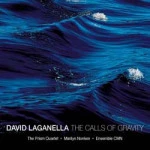
David Laganella has released a disc on the New Focus label entitled The Calls of Gravity. The composer writes that the title “is a reference to a technique that is prevalent in many of my works in which musical objects are attracted towards each other, some objects with greater mass than others.” This plays out in music that is more interested in fierce gestures and active textures than melody or harmonic progression. In Leafless Trees, The Prism Saxophone Quartet creates molten sound images, with bent pitches, carefully shaped vibrato and alternately frantic and static gestures. The deformations of sound that make sax piece so striking are less accessible on the piano, and The Hidden River is less successful for it. I found The Persistence of Light, the second of the two piano pieces on the disc, to be more effective because of the clarity of the dichotomy between aggressive and lyrical modes of expression. Sundarananda, a trio inspired by woodworker George Nakashima, is the exception to the aggressive tone that predominates on the disc, being gentler and more lyrical, with hints of folk melody. Laganella has enlisted some superb performers here, including Ensemble CMN, but especially Prism and pianist Marilyn Nonken who bring plenty of fire to their performances.

Finished “Finishing”

I finished reading Stephen Sondheim’s Finishing the Hat last week, his first volume of collected, annotated lyrics. A few random comments:

-Reading the lyrics is enjoyable, but what I really ate up was the commentary, both the notes on Sondheim’s own songs, and the mini-essays on canonical music theatre composers. As some reviewers have noted, Sondheim is very critical of his colleagues - Lorenz Hart is “lazy” for example. I have to say that my awe of an artist like Hart always led me to assume that my slight discomfort with the last word in the couplet “your looks are laughable, unphotographable” (in “My Funny Valentine”), was my problem, not a flaw in the lyric. Sondheim throws the blame on Hart, saying “unphotogenic” is what is really meant, and “unphotographable” is sloppy.

-As a composer I longed for commentary on the music itself, the notes and rhythms. A truly technical discussion would not be possible. The level of musical literacy, even among the elite population (the “general public” - ha!) that would buy this book, is appallingly low. But surely there could have been a less technical discussion that would engage, for example, the play of motives in Sweeney Todd, or would expand on Sondheim’s assertion that the languages of  both Ravel and Rachmaninoff were models for A Little Night Music. (Ravel obviously, but where is the Rachmaninoff?) I also wish there were annotations on the reproductions of lyric drafts that appear throughout the book, and more draft pages with musical notation. The book is already big, and asking for even more is probably unreasonable - but still, the commentary is what I found most interesting in the book.

-It seems odd that a book proclaiming that “God is in the details” right on its very endpapers should have more than one page where an analytical comment is stated both in the body of the text and in a footnote on the same page.

Sondheim on Colbert here.

Upcoming in NYC and DC

- February 10 at Symphony Space in NYC, Sequitur plays pieces by Eric Moe and Randall Woolf based on texts by David Foster Wallace.

- February 12 at the Smithsonian American Art Museum in DC, the 21st Century Consort plays Stravinsky, Paul Schoenfield, Jennifer Furr, Bruce Macombie, and Jacob Druckman. A brief interview with Christopher Kendall, who directs the Consort, is found here.

Bernard Rands Piano Preludes

Reading about the recent first performances given by Jonathan Biss of a new piano work by Bernard Rands made me take down Bernard’s Preludes for piano from the bookshelf. This is a set of 12 character pieces written for Robert Levin and premiered in 2007. The works have Italian titles - Ricercare, Toccata, and some less familiar ones, like Istampita and Bordone. The Italian angle is also reflected in the set’s two memorial pieces, one for Luciano Berio, the other for Donald Martino. Bernard’s ear for exquisite harmony is evident throughout as is his interest in structures that proliferate in a gradual process - for example, the efflorescing lines set against detached chords in the opening Ricercare, or the gradually more elaborate harmonizations of a recurring chorale tune in Ritornello-Rallentando. This type of variation technique, with a clearly repeated structural basis, is familiar from works like Rands’s Bolero-like Ceremonial for wind ensemble, or, in a more lyrical vein, the second movement from the first Le Tambourin Suite. The pianism in the preludes ranges from relatively stark to quite virtuosic.

Bernard and his wife Augusta Read Thomas have a large number of recordings posted online here - look for the folder with Bernard’s music. UPDATE: Find recordings of Augusta’s music here. bernardrands.com does not have the recordings of his music that Gusty’s old site did. The score of the Preludes is published by Schott. Video of Jonathan Biss on the new Rands piece here and here.

Ode to Eternal Pine

Network for New Music’s season-long Asian theme continues with a program of music by Chinese composers on Sunday, February 13 at 7:30. The concert will be at the Settlement Music School, 416 Queen St. in Philadelphia. I will be involved, leading a pre-concert chat with composers Shih-Hui Chen and Chou Wen-Chung at 6:30, and recording a podcast discussion with Wen-Chung earlier in the day.

The program features a nice multi-generational mix - Wen-Chung, one of my teachers from my Columbia University doctoral studies, is the elder statesman of the group at 87, while the youngest is Huang Ruo, born in 1976, and Shih-Hui Chen and Bright Cheng are from a middle generation. Wen-Chung is a particularly intriguing figure. The kind of cross-cultural mix where Asian and Euro-American practices mingle that we associate with composers like Bright Cheng, Tan Dun and Chen Yi was actually pioneered by Wen-Chung. In fact, it was he who brought those younger Chinese composers to the United States to study at Columbia through his work with the US-China Arts Exchange. (If you know the film “From Mao to Mozart“, you know something about Wen-Chung’s efforts.) In addition to his work for cultural exchange, Wen-Chung is especially well known as the student, assistant, and musical executor of Edgard Varèse. In fact, the Varese connection has sometimes overshadowed Wen-Chung’s own compositional work, so it is nice to see his music getting some attention. Ode to Eternal Pine, the piece by Wen-Chung that Network will play, was commissioned by the New York New Music Ensemble, and is based on an earlier work, Eternal Pine,  that was composed for  an ensemble of Korean instruments. Ode to Eternal Pine is scored for Western instruments, but the playing style and technique is thoroughly influenced by East Asia musical sensibility, with an emphasis on fluidly shaped gestures with respect to pitch and rhythm. You can find score and recording excerpts of the piece at Wen-Chung’s exceptionally rich website.

I’ll be interested to get to know the music of Shih-Hui Chen. The piece she has composed for this concert is inspired by the aboriginal people of Taiwan. It is intriguing to read what she writes in her program note, that the aboriginals of Taiwan “encountered Dutch Christian missionaries in the early 17th century before the arrival of the Han people from China.”  Who would have thought that Christianity would occupy, as she writes, “a more prominent place [for the aboriginals] than traditional mythologies.” Her new piece is called Our Names and sets a text by a blind aboriginal poet, a plea for justice and respect for aboriginal people and their culture.

Four young musicians from the Philadelphia Sinfonia, directed by Gary White, will perform Fantasia, the first movement of Shih-Hui Chen’s string quartet Mei-Hua at 7:15 before the Network concert performance begins at 7:30 PM. Go here for video about this project.

(photo above: Chou Wen-Chung)