The Boston Symphony began its two-year cycle of Harbison symphonies last night, with a performance of the Third. Go here for audio and video on the program, (click on BSO Media Center) which also includes the Mahler Fifth.
Tag: John Harbison
Gatsby Marginalized
 In a recent New Yorker article about a theatrical adaptation of The Great Gatsby that involves reading the entire novel on stage, Rebecca Mead reviews the various theatrical and cinematic adaptations of the book that have been done over the years. She includes various absurd failures, but fails to mention the most successful adaptation of the piece: John Harbison’s 1999 opera, premiered at the Met late that year. Maybe she knew about the piece and left it out because the excellence of Harbison’s work would conflict with the point she was trying to make about how impossible the novel is to adapt. More likely, I fear, she simply didn’t know the piece existed. Again, to repeat a motif often found in these posts - one of the musics I love has been marginalized - in this case, pushed right out of the picture.
You can hear Gatsby on CDs that the Met is selling as part of a big 32-disc set honoring James Levine on his 40th Anniversary with the company. You have to buy the whole set, no individual items for sale just yet. Too bad the piece didn’t get included in the Levine DVD set that has also been issued - though that does include both Berg operas, Weill’s Mahagonny, and Corigliano’s Ghosts of Versailles. Hear Lorraine Hunt-Lieberson sing an excerpt from Gatsby here.
Luminism in Albany
 L to R: conductor and music director of the Albany Symphony David Alan Miller, composers John Harbison, James Primosch, and Stacy Garrop
I’ve already blogged about my recent experience in Albany here, here and here, but am only now getting around to a word about how the May 22nd concert went. David Alan Miller, Albany Symphony music director, began the program with two new movements from Stacy Garrop’s planned Mythology Symphony. Her Becoming Medusa was performed by the Albany last fall (you can hear the performance here), and at David’s suggestion, she is adding additional movements to the piece. The new ones deal with The Sirens and The Fates. She has a handle on a big orchestral sound, with grand, vivid, even overpowering gestures (perhaps there is a Christopher Rouse influence here?). Both new pieces drive to huge climaxes; in the Fates movement, the peaks contrast with some eloquent (and beautifully played) solo cello writing. Stacy says she is planning a Pandora movement to round out the piece. It is a smart strategy to write independent pieces that can combine to make up a grander vision - think of George Tsontakis’s T.S. Eliot pieces; Rouse’s Phantasmata; Carter’s big Symphonia; and Augusta Read Thomas’s Helios Choros ballet tryptich (go here and scroll down), worthy pieces all. Or at least it seems like a smart strategy. The problem is to get the entire set performed as a unit. This partly has to do with the problem of the second performance that I wrote about here; but it also has to do with the unavailability of a 40 minute slot for a new piece on an orchestral concert.
The best thing about the next piece on the program, a percussion concerto by Finnish composer Einojuhani Rautavaara, was the commanding performance by soloist Colin Currie, who is perhaps best known for his performances and recording of Jennifer Higdon’s Grammy-winning Percussion Concerto. I found the Rautavarra rather square and unimaginative. It is saying something when the most interesting composing in a concerto is the cadenza which has been written not by the composer, but by the soloist! Currie is a remarkable virtuoso, and made as much as he could of the often stiffly constructed solo part. I hope to hear him in a more inspired work soon.
My own Luminism followed the intermission. (You can read my program note here.) Rather than try to describe it more, I’ll let you hear it for yourself when it becomes available on Instant Encore. For now, I’ll just report that David and the Albany did a fantastic job - David paced the piece beautifully, there was wonderful solo playing (thank you, horns, for the beautifully echoing nocturnal passage), and the full ensemble had power and precision.
The concert closed with a suite from John Harbison’s opera The Great Gatsby. Berg extracted a Lulu Suite from his opera, but he also planned a Lulu Symphony, and Harbison’s suite tends toward the symphonic in character. Although sometimes the transitions are abrupt, the piece is more than a simple stringing together of excerpts. There is something symphonic about the tension created when the 20s style pop tunes Harbison created are juxtaposed with the music for the story’s more dramatic moments. Both kinds of music share some of the same motivic material and it is as though that material is being developed in two different keys. With the music alone, Harbison is able to convey something of the expressive impact of the opera on this smaller canvas. Take the words and scenery out of many contemporary operas, and you will have mere background music. That’s not the case with Gatsby. There is an affecting drama deep in the music’s bones.
Apart from this symphonic drama, there is plenty of charm in the piece. The witty, expertly crafted 20s songs - foxtrots, a tango, and so forth - are played by a sort of cafe orchestra embedded in the larger ensemble. There are sometimes tiny hints of Ives when the pop songs collide with something else - for example, a very high, soft violin obligato played over one of the pop tunes feels like something from another world - and I would have enjoyed more of that. Let’s hope this impressive suite inspires more productions of the opera itself.
It was a fantastic experience in Albany. David, let’s do it again soon!
Luminism
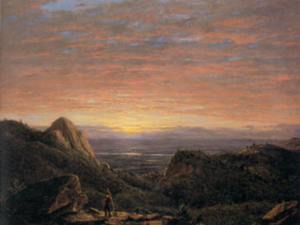 Later this month, I will be traveling to Albany for the premiere of my new orchestral piece, Luminism, to be played by the Albany Symphony, led by David Alan Miller. This is part of the Albany’s American Music Festival, and the program will include music by John Harbison, Stacy Garrop, and Einojuhani Rautavaara. The concert takes place at EMPAC, a performing arts center on the campus of Rensselaer Polytechnic Institute.
Here is my program note for the piece:
=-=-=-=-=-=-=-=-=-=-=-=-=
When David Alan Miller invited me to compose a new work for the Albany Symphony, he asked me to consider writing a piece inspired by the paintings of the Hudson River School, the so-called Luminist painters. As I got to know the work of such painters as Thomas Cole, Albert Bierstadt, Frederic Edwin Church, and others, I took pleasure in their intense and sumptuous effects of light as it illuminates varied landscapes. I noticed how these painters explored the light of different times of day – dawn, moonlight, day, sunset. My work does not reflect on specific paintings, but is a meditation on the various forms of light throughout the day, as conveyed in Luminist painting. The piece is framed by passages that suggest the absence of light: I needed night to make day glow more intensely.
=-=-=-=-=-=-=-=-=-=-=-=-=
The Albany Symphony is playing very well these days - just listen to some of their numerous recordings. I am very much looking forward to reuniting with David (our first encounter goes back to a New York Youth Symphony premiere in 1987) and with the Albany Symphony (they premiered my Some Glad Mystery in 1992).
The image above at left is Morning, Looking East Over the Hudson Valley from the Catskill Mountains by Frederic Edwin Church, from the collection of the Albany Institute of History and Art.
Composition Inflation
 Bruce Brubaker has posted recently on the topic of repertoire inflation - the tendency of young pianists to take on gargantuan pianistic challenges at an unnaturally young age - high school students playing the Liszt Sonata or Gaspard. I share his concern - there is something absurd about the first Beethoven sonata you learn being Op. 111.
I fear that something similar that can happen in composition: the young composer who tries to write a 40 minute cantata when it might be a better idea to craft a well-made 10-minute song tryptych. Not that students shouldn’t set the bar high - it’s important to challenge oneself. After all, the reverse can also be a problem, the student who is too easily satisfied with presenting a few sparse ideas without really digging in and exploring the material. (This kind of piece usually comes with cute movement titles.) As always, the challenge is to come down in “the place just right”.
Composition inflation can affect composers later on in their career, resulting in pieces that strive for extreme emotional content, sometimes with good results, sometimes not.
40 or 50 years ago, undoubtedly in the shadow of The Bomb, there developed a genre of apocalyptic pieces: Don Erb’s The Seventh Trumpet; Crumb’s Star-Child (complete with an army of tom-toms depicting the Four Horsemen of the Apocalypse) and Black Angels; Richard Wernick’s Visions of Terror and Wonder; Rochberg’s Apocalyptica; the Ligeti Requiem; Karel Husa’s Music for Prague might fit in here. Penderecki’s Threnody for the Victims of Hiroshima is perhaps an early example, with Messaien’s Quartet for the End of Time being the progenitor a generation earlier, and with works by Berlioz, Verdi and Mahler in the background. Christopher Rouse is the prime exponent currently, and handles it masterfully. Don’t get me wrong, I love many of these pieces. It is just that the apocalyptic genre is not for every composer, and shouldn’t be for every piece.
I first started thinking about this when I heard John Harbison’s bass concerto a few years ago. I was struck by how the piece was content to be what it was - that it didn’t have to carry stupendous emotional weight or an apocalyptic scenario. I don’t mean it was dry - the piece is elegant, imaginative, and expressive without sentimentality. Now, in part this has to be ascribed to the medium - it is hard to imagine a bombastic double bass concerto. But it also can be traced to John’s willingness to write something that didn’t have to compositionally or emotionally show off (the soloist does get to shine, of course.) It is a little easier to do this when you have more opportunities to write for orchestra, since there is less pressure to make a single piece be everything and do everything.
I hope my own music has enough expressive range to encompass the explosive and the playful, the intimate and the epic - but not necessarily all of those in every piece.
Emmanuel Church interviews
The Boston Musical Intelligencer has a pair of interviews with John Harbison - in his capacity as acting music director at Emmanuel Church - and the Rev. Pamela Werntz, who is to be installed as the new rector at Emmanuel this Sunday. As I wrote about earlier, my motet Spiraling Ecstatically will be done at both the morning prayer service and the installation service/Eucharist in the afternoon. Spiraling sets a poem of E. E. Cummings, and is a revision of a piece I wrote for the choir of the Catholic Campus Ministry during my student days in the Columbia University doctoral composition program.
Notes-and-Rhythms
Anthony Tommasini’s Arts and Leisure essay in the Times today speaks about the end of dogma in programming new music, citing an evening by the Ensemble ACJW at Poisson Rouge to make the case. Tommasini mentions the stylistic debates that dominated the lunch table during his time as a student at Yale, but it is not news that those arguments have quieted down.
More interesting to me in the article is the staying power of the high modernist composers that everybody is supposed to hate (the article mentions Babbitt and Davidovsky among others). It turns out that the music is less about compositional ideology (Davidovsky in particular is the most asystematic of uptown composers) and more about - among other things - a celebration of virtuosity. Since a performer is always happy to play something that makes him/her sound brilliant, it is not surprising that Ensemble ACJW would program Davidovsky’s Synchronisms #9 or that the Jack Quartet would advocate for Xenakis, or that the superb violinist Miranda Cuckson would issue first-rate discs of music by Shapey and Martino (about which more in a future post).
The other point of interest for me is one that Tommasini makes, but then backs away from as a “passing worry for now”, and this is the problem of the neglected “notes and rhythms” composer, to use the playful phrase of John Harbison that the article quotes. Tommasini mentions Hartke, Stucky, Rouse, Melinda Wagner, Currier, and Tower as (quasi-)mainstream voices that may be “slipping from the view of young musicians and audiences”. (I say “quasi-mainstream” because “mainstream” is a pretty vexed concept today. Also, check the composer links at right if you want to add more names to the list.) Part of the problem here is that these composers offer journalists or publicists little on which to hang a story - nothing about identity politics, technology or violent rebellion against mentors - merely excellent music. (The exception on that list being Sebastian Currier, whose impressive use of multimedia has not yet received the recognition it deserves.) If these composers are “slipping from view”, it is because their pieces all too often “slip away” after the premiere - the problem of the 2nd performance that I wrote about earlier. This is not a “someday” problem, as Tommasini suggests; rather, it is a problem now. Shouldn’t there be a dozen flutists planning to play Melinda Wagner’s Flute Concerto? Shouldn’t there be young groups touring with the string quartets of Harbison or Currier? In a healthier musical climate, repeated performances would mean the merely excellent would remain squarely before us instead of slipping from view.
Overton overtones
Yet another important post by Ethan Iverson at Do the Math, this time on Hall Overton, the fellow I mentioned below in connection with Robin D. G. Kelley’s book on Monk. Let me add a couple of points around the margins of the post:
-A good survey of the music of Miriam Gideon - perhaps my favorite of the “mid-century classical music women geniuses” mentioned by Iverson - can be found on New World Records. I believe Gideon is best known for her vocal music, but this retrospective disc includes both vocal and instrumental pieces, including a very fine piano sonata. (Correction: The New World album has many fine pieces, but Gideon’s piano sonata is actually on a different disc, an older CRI recording, with Robert Black playing. Should not have relied on my memory of the contents of that disc! New World Records is handling the tremendous catalog of the late lamented Composers Recordings Inc., and has re-issued the more recent albums on CD. Their site seems to say that while earlier CRI recordings will eventually be put on CD, the old LPs are still available - though I would have to say I haven’t tried to order one. Ethan Iverson, who has been trying to track down the Gideon sonata score and recording, has written to New World about this. The score, by the way, is available through American Composers Alliance.)
-Iverson mentions attending a concert by Robert Helps playing Roger Sessions, a program also attended by, among others, Garrick Ohlsson and Alfred Brendel. Ohlsson, who is a wonderful advocate for Wuorinen, would be fantastic in Sessions, the Second or Third Sonatas in particular, rather than the more introverted First. But try to imagine Brendel playing Sessions; it’s hard to know what to think. The Schoenbergian side of the music would come to the fore?
- Myriad classical composers have worked as jazz pianists (as an example, find out about John Harbison’s recordings from the Token Creek Chamber Music Festival here), but I agree with Iverson that it is tough to come up with classical composers who played piano with jazz musicians of historic importance as did Overton and Mel Powell. There was a legend around my undergrad school that one of my teachers, the late composer Rudolph Bubalo, had played piano for Sarah Vaughan; no way of confirming that now, surely no recordings to document it. If you look beyond the piano for a musician performing on a truly high level in both classical and jazz worlds, the first composer you would bump into would be, of course, Gunther Schuller. A less well known example is the late Donald Martino, who was a good enough jazz clarinetist to have played with Bill Evans. I’d be interested to hear what Iverson would have to say about Martino’s quite superb piano music. Martino’s Fantasies and Impromptus is very high on my list of greatest American piano pieces. (Note that the link is to a disc that includes Robert Helps’s reading of the Sessions Third as well as Martino’s Fantasies and Impromptus.)
