Links for Holy Week

OK, since I outed myself as a Catholic in my papal rant, and since it is Holy Week, it seems like a good time to add a new category to the blog roll - religion and spirituality. Listed there are some communities, organizations, and resources I have found nourishing over the years.

I still haven’t followed through on my plan to discuss some recent listening - discs of Shapey, Wolpe, Martino, and Ellington - but hope to do so before too long - probably early next week, given that there will be a blog hiatus during the Easter Triduum.

Music and the pope

I write this as a cradle Catholic who will be playing the piano at my parish’s Palm Sunday Mass tomorrow morning.

I was deeply disgusted by the article on Pope Benedict and music in today’s New York Times.

My first problem was with the article itself. It reminded me of Anthony Tommasini’s piece on Condalezza Rice’s piano playing a while back: both articles are not about music at all, but about a  person in a position of great power who happens to be an amateur musician. It is shameful to waste column inches on amateurs when professional performers, composers, and recordings go unnoticed. Does Roberta Smith, art critic for the Times, write about the paintings of Tony Bennett?

The more profound cause for disgust is to read about the “servant of the servants of God” living like a Renaissance prince, about  his retinue being concerned about such matters of import as which of his several thrones the pope should use while listening to Haydn, or the utter idiocy of fretting over whether a female violist should perform with her head covered in the Pope’s presence. So much for the church’s preferential option for and solidarity with the poor. The whole thing bespeaks the sin of clericalism, the exalting of the clergy, the defining of the church as the clergy, the same spirit that leads the institutional church to protect itself rather than protect children from abuse. The article makes passing mention of the stink of corruption throughout the church hierarchy arising from continuing revelations in the ongoing abuse scandal. Are people who sit on thrones above the law? When will the institutional church ever admit to its complicity with the crimes of the abusers? When will a bishop go to jail?

So the Pope has good taste, he loves German music? then why not listen to the Seven Last Words the Haydn the way wrote it, instead of in a kitschy modern vocal adaptation?

So the pope loves German music? So did some Germans of an earlier generation, say, the 1930s and early 40s…

At tomorrow’s Palm Sunday service, as I remember my own sins, I will continue to pray for my beloved church that makes me so angry and sad.

Codex; New Voices

Upcoming concerts:

counter)induction presents “Codex” - according to their announcement:

“A concert that Borges might have planned: starting with a unique and mysterious collection of late-medieval polyphony from the codex Torino J.II.9, five composers engage in “speculative musicology” to create works in a musical tradition that never was. Composers Peter Gilbert, Christopher Jon Honett, Douglas Boyce, Kyle Bartlett and Ryan Streber imagine a centuries-long musical practice to arrive at five world premieres that are as evocative as they are unique.”

Works by Charles Halka and Christopher Rogerson round out the program, this Sunday, March 28 at the Tenri Institute. I know from hearing these players at Penn not too long ago that c)i is one of the strongest groups now active in NYC.

=-=-=-=-=-=-=-=-=-=-=-=-=-=-=

The Philly chapter of the American Composers Forum presents “New Voices” - six world premieres by ACF composers working in the Philadelphia area - Ryan Beppel, David Carpenter, Heidi Jacob, Andy Laster, Ian Munro, and Kento Watanabe - as well as Mario Davidovsky’s Festino Notturno. The Argento Chamber Ensemble performs, at the Prince Music Theater, Saturday, April 3.

Nobilimente

Sorry to not have been posting for a bit, will try to catch up in the next few days with some posts about CDs to which I have been listening.

For now, let me briefly note that despite the potentially morale-sapping news coming out of the Philadelphia Orchestra these days, they sounded superb at last night’s concert. I attended so I could hear Sir Andrew Davis, who conducted the premiere of my Songs for Adam with the Chicago Symphony last fall. The program was Mozart and Elgar - Clemanza di Tito overture, 4th violin concerto with Stefan Jackiw, and Elgar 1. Avery Fisher Grant winner Jackiw was very impressive: a slightly cold edge to the sound of his first entrance was quickly replaced by warmth and brilliance. He offered an encore, a remarkably languorous Bach largo.

Elgar is not my favorite composer, but last night’s symphony sounded more like chamber music than movie music. Davis and the Philadelphia traded richness and sheer beauty of sound for the more usual bombast associated with this piece, and formally it hung together better than it usually does.  The subtlety of Elgar’s orchestration was emphasized. Listening from the front of the 3rd tier in Verizon Hall was better than what I have experienced in seats lower down, where the orchestra can sound like it is playing from a greater distance than is actually the case. The program made me more appreciative than ever of how fortunate I was to work with Maestro Davis on Adam.

Diabolic Diabelli

Now that my piece for the Albany Symphony, “Luminism“, is in the capable hands of Ken Godel, who is computer engraving the score, I can turn my attention to the next project: a contribution to a collection of 25 variations by 25 composers on the theme of Beethoven’s  Diabelli Variations (click on the image at left for an IMSLP link to the score of the Beethoven) to be premiered at the 25th anniversary celebration of Network for New Music here in Philadelphia. The event takes place at the Queen Street branch of the Settlement Music School in Philly, on May 2. Go here to see the list of composers involved; the styles represented are nicely diverse. The title of this post is the title of my piece, and comes from the fact that I have re-imagined the harmony of the theme using stacks of tritones, the good ol’ diabolus in musica, as the theorists tell us.

Composition Inflation

Bruce Brubaker has posted recently on the topic of repertoire inflation - the tendency of young pianists to take on gargantuan pianistic challenges at an unnaturally young age - high school students playing the Liszt Sonata or Gaspard. I share his concern - there is something absurd about the first Beethoven sonata you learn being Op. 111.

I fear that something similar that can happen in composition: the young composer who tries to write a  40 minute cantata when it might be a better idea to craft a well-made 10-minute song tryptych. Not that students shouldn’t set the bar high - it’s important to challenge oneself. After all, the reverse can also be a problem, the student who is too easily satisfied with presenting a few sparse ideas without really digging in and exploring the material.  (This kind of piece usually comes with cute movement titles.) As always, the challenge is to come down in “the place just right”.

Composition inflation can affect composers later on in their career, resulting in pieces that strive for extreme emotional content, sometimes with good results, sometimes not.

40 or 50 years ago, undoubtedly in the shadow of The Bomb, there developed a genre of apocalyptic pieces: Don Erb’s The Seventh Trumpet; Crumb’s Star-Child (complete with an army of tom-toms depicting the Four Horsemen of the Apocalypse) and Black Angels; Richard Wernick’s Visions of Terror and Wonder; Rochberg’s Apocalyptica; the Ligeti Requiem; Karel Husa’s Music for Prague might fit in here. Penderecki’s Threnody for the Victims of Hiroshima is perhaps an early example, with Messaien’s Quartet for the End of Time being the progenitor a generation earlier, and with works by Berlioz, Verdi and Mahler in the background. Christopher Rouse is the prime exponent currently, and handles it masterfully. Don’t get me wrong, I love many of these pieces. It is just that the apocalyptic genre is not for every composer, and shouldn’t be for every piece.

I first started thinking about this when I heard John Harbison’s bass concerto a few years ago. I was struck by how the piece was content to be what it was - that it didn’t have to carry stupendous emotional weight or an apocalyptic scenario. I don’t mean it was dry - the piece is elegant, imaginative, and expressive without sentimentality. Now, in part this has to be ascribed to the medium - it is hard to imagine a bombastic double bass concerto. But it also can be traced to John’s willingness to write something that didn’t have to compositionally or emotionally show off (the soloist does get to shine, of course.) It is a little easier to do this when you have more opportunities to write for orchestra, since there is less pressure to make a single piece be everything and do everything.

I hope my own music has enough expressive range to encompass the explosive and the playful, the intimate and the epic - but not necessarily all of those in every piece.

Revisiting Fred Hersch

David Hajdu’s article on Fred Hersch in the Times Magazine several weeks ago led me to pull out some of his recordings, in particular the 3-CD set he released on Nonesuch in 2001. I’m especially fond of the solo work that dominates this album. One highlight is the astonishing version of Cole Porter’s  “So in Love”. In the booklet notes Hersch calls it “probably the slowest ballad I ever recorded.” The performance lasts nearly 8 minutes, yet consists of a brief intro, a coda, and only two choruses! Now, part of the deal on that is the form* of the song. Porter notated the piece in cut time, with the opening notes of the melody (“Strange dear, but true dear”) notated as half, half tied to half, half, etc. This means the form of the piece is the usual AABA, but each section is 16 bars, except the last A which is extended. Does anyone play the piece as though the tune was written in 4/4 quarter notes - with a walking quarter note bass? The number of bars would obviously be halved, and the piece would be closer to a conventional 32 bars (plus that extension). Why does the mind rebel at that idea? The booklet notes say that Hersch usually plays the piece in 5/4 - presumably a bar of 5/4 for each bar of cut time - a vastly more sophisticated way of filling in those long measures than the usual cocktail piano strategy of a bossa nova or even, Lord help us, a rhumba feel. The song is from Kiss Me Kate, and the performance on the Broadway cast album is about 72 to the half note, a solid andante. Hersch plays the piece with a basically steady quarter note pulse of left hand chords at  about 60, but he plays the piece in 6/4! (Or, call the pulsing chords triplets - the notation would differ, my point is the same.) Two bars of cut time are covered in 6 pulsing chords. So: on Broadway, two measures of cut time lasted 4 beats at 72 (3.33 seconds); in Hersch’s version, two bars of the original cut time now last 6 beats at roughly 60 (6 seconds) (or 3 beats at 30, if you like, which would be off the metronome). The 6/4 feels utterly natural, so much so that at first I thought the piece was being played in 4/4, with generous rubato. There certainly is rubato here, but the metric framework has been altered from the original version.

Of course, just playing slowly is no special feat (after all, we’ve all worked with drummers who seemed to make a specialty of it, and I don’t mean that in a positive way.) What makes the performance a tour-de-force is the way Hersch is able to spin out a line that keeps up the continuity despite the luxuriously slow pace. The duple/triple tension between the pulsing chords and the tune helps keep the melodic thread taut. It feels a bit like the slow movement of the Ravel Concerto in G** with its steadily pulsing left hand chords, though the right hand melody in the Ravel does not offer an opportunity for the wonderfully elastic rubato that Hersch brings to bear here.

Hersch remarks in the booklet about this tune that “as a solo, it struck me more as an intimate confession between one person and another, almost like whispering in bed.” It’s an apt image for a haunting performance. Pillow talk may be intimate like this recording, but never this eloquent.

_____________________________________

*Allen Forte (yes, the same fellow known for writing about post-tonal music) writes perceptively about the superbly shaped melody of this piece in The American Popular Ballad of the Golden Era.

**John Adams has recently blogged interestingly about Ravel here.

O Sapientia/Steal Away

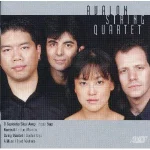
The highlight of the newly released Avalon String Quartet CD on Albany is O Sapientia/Steal Away by Hayes Biggs. Hayes was a colleague of mine in the Columbia doctoral composition program. I have long felt his music deserves wider recognition; perhaps this disc can help make that happen.

The compound title of the piece refers to its sources: Hayes’s own motet on the Advent antiphon “O Sapientia” (“O Wisdom that proceeded from the mouth of the Most High, Come and show us the way of prudence.”) and the spiritual “Steal Away” (“Steal away, steal away, steal away to Jesus”).  These are woven into a compelling narrative that plays continuously. The piece begins with darkly charged chords, starting from e-flat minor, which frame more lyrical music, including the “Sapientia” material. A scherzo interrupts, “obsessed” as the composer puts it, with repeated notes, but also including witty references to similar gestures in Beethoven and Mozart quartets. The material of the first part returns, yielding to a disconsolate meditation on “Steal Away”, hauntingly tentative at first; later, more lyrically extended. The piece ends with tender, high register harmonies, imbued with the intervalic colors of the “Steal Away” melody - essentially tonal harmonies, like the piece’s opening, but seen now in a very different light, a world away from the intense, brooding sounds with which the piece began.

The style of the piece is not easily categorized, perhaps occupying a spot a bit to the left of late Britten. Such comparisons are inadequate; Hayes’s language is his own. I found the form of the piece engrossing, the harmonies varied and telling, the string writing idiomatic - and the emotional content powerful.

There are so many fine young string quartets these days that the Avalon may have not yet come to your attention. It should. They play the Biggs piece with passion and precision, sensitively varied colors, and impeccable pacing.

This disc includes music of interest by David Macbride, Stephen Gryc and Ethan Wickman, but it is Sapientia that most strongly continues to claim my attention.

Thank you, Emmanuel

I am back from Boston where I attended performances of my Spiraling Ecstatically at Emmanuel Church. I wrote about this in previous posts here and here. For now, I want to thank the superb choir of Emmanuel Music, with its new Music Director, Ryan Turner, who conducted my motet; John Harbison, acting Music Director, and Pat Krol, Executive Director of Emmanuel Music, both of whom made so many things possible; and the community that is Emmanuel Church, for their kind interest in my work. Warm congratulations to Rev. Pamela Werntz, the newly instituted Rector at Emmanuel. She presided and preached at the morning prayer service yesterday,  breaking open the Word in a deeply nourishing way. (Go here and click on sermons to read examples of her work.) Emmanuel is in good hands. I’m grateful for the presence of this community in my life.

Update: Read more about the events of the day in the Boston Musical Intelligencer review. Update #2: Pamela Werntz’s wife Joy blogged about the celebration here.