
Tag: Bridge Records
To-Do List
 It isn’t entirely about picking up a pencil and staring at a blank sheet of manuscript paper, this composing thing. As a way of letting you know about some things that are happening soon, here is a list of stuff I have to do in the next 6 weeks or so:
- I have a considerable backlog of scores that are not in as nice shape, graphically speaking, as I would like, and I haven’t yet supplied the master copies of them (well, these days, PDF files) to Theodore Presser Co., my publisher. However, I am slowly addressing the issue with the help of master editor/engraver Ken Godel. Ken has recently sent me files of both the piano/vocal and chamber ensemble versions of my song cycle Holy the Firm, and I am proofing them one more time. I hope to finish this in the next few days.
- Bridge Records has sent me the first draft of the booklet for the CD of my vocal music they will be releasing soon. I need to proof this, not only for the content (texts of the songs, bio notes, etc.) but to offer suggestions on the graphic appearance and layout. This needs to be done by this coming Monday.
- The Folger Consort will be performing my Songs and Dances from “The Tempest” in January, and I need to get the score and parts to them by the middle of this month. The varied instrumentation of the piece (it is scored for a wide array of early instruments) will be handled by a different, larger array of performers than was the case at the premiere some 15 years ago, and parts have to be devised to reflect this division of labor.
- In January I will be playing the slow movement, a set of variations on “Sometimes I Feel Like a Motherless Child”, from my Piano Quintet, with the Daedalus Quartet on a program at Penn. Again, that score needs to be cleaned up graphically - my Finale chops have improved a bit since 1996, as has the program itself, of course. The Daedalus wants to see the parts by the beginning of December. (By the way, the Daedalus gave a wonderful concert yesterday at Penn, with works by Schulhoff, Korngold and a rare performance of the Schoenberg Ode to Napoleon, with pianist Charles Abramovic and baritone Randall Scarlatta as narrator. It’s a remarkable piece. Charlie described it to me afterwards as being “as crowd-pleasing as Schoenberg from that period gets.” I had only heard the piece live once before, a performance at Columbia University, with, of all people, Wallace Shawn as narrator.)
- My new song for Lyric Fest on a text by Susan Scott Thompson is also due in December; I want to look it over one more time before sending it in - for once I finished something far enough in advance that I have time to make final adjustments after letting the piece rest for a bit. It’s amazing what you see when you come back to a score after even a few weeks.
Sacred Songs on Bridge Records
 I’m very happy to report that Bridge Records will be issuing a new CD of my music in early 2014. The disc, to be called Sacred Songs, will bring together four of my pieces for voice and ensemble:
- From a Book of Hours sets four poems of Rainer Maria Rilke in German.
- Four Sacred Songs comprises arrangements of old traditional sacred melodies - plainchant as well as metered tunes - with Latin texts.
- Dark the Star brings together texts by Philadelphia-based poet Susan Stewart, Rilke (in German), and a verse from the Psalms (in Latin).
- Holy the Firm sets texts by three American women - Denise Levertov, Annie Dillard, and Susan Stewart - as well as John Climacus, a monk of the 7th century Sinai desert.
The performers are Susan Narucki, soprano, William Sharp, baritone, and the 21st Century Consort, led by Christopher Kendall.
While I am very grateful for every CD of my music, (visit the discography page to get the details on how much I have to be grateful for), this new Bridge project is especially meaningful to me. This is partly because it is the first disc devoted entirely to my vocal music, a medium that has been a major preoccupation of mine in the last two decades. It also documents an especially long-standing relationship with performers who have been among the most consistent advocates of my music. In fact, I think that over a period of more than three decades, Christopher Kendall has conducted and/or programmed my music more than any other musician anywhere!
There is a lot more to say about this album - the pieces, the performers, the process of recording with Curt Wittig and editing with George Blood, the booklet essays by Susan Stewart and John Harbison, and I will be writing about these things in future posts. For now I will leave you with the photo above. This is the interior of St. Henry’s Ecumenical Art Chapel, designed by the firm of Sanaksenaho Architects, and photographed by Jussi Tiainen. This powerful image will be used for the cover of the booklet accompanying Sacred Songs.
Wednesday Miscellany
- I should have looked on YouTube for music by Melinda Wagner when I wrote that post about her Trombone Concerto. Only now did I think of doing so: here and here are excerpts from Four Settings, the vocal piece on the same Bridge CD as the concerto. Soprano Ilana Davidson is featured.
- I’ve added Lawrence Dillon’s blog called An Infinite Number of Curves (I knew a girl like that once) to the right hand column.
- Sorry I messed up the links in this post below - they are now fixed - you may want to visit it again.
Melinda Wagner’s Trombone Concerto
 Melinda Wagner‘s Concerto for Trombone and Orchestra begins unpretentiously, with a delicate version of the composite attack/decay that is a standard opening ploy for so many pieces: a soft single note from the harp and timpani, with the decay provided by half the second violins, tremolo. Then the first phrase from the soloist is heard: pianissimo, curving up and then down. The pitches can be parsed into two octatonic scale segments, with that sustained tremolo note shared by the two segments. But what you attend to is not the harmonic structure, though that is what gives the phrase coherence; rather, what is most striking is the simple elegance of the shape, with its minor thirds to begin and end, with its highest pitch sounding like an upper neighbor, resolving down by step. Reiterations of the orchestra’s opening sustained note are fitted around the phrase at exactly the right time. For example, the highest note of the trombone phrase is also the longest note, so that’s the place for a fresh harp pluck. The rest of the second violins sneak in as the soloist reaches his cadencing minor third, and repeated horn notes affirm the end of the phrase. These opening bars are poised, suave, satisfying in a modest way. But what happens next raises the stakes.
It is an effect created by an different sort of composite sound: violas, cellos and contrabasses divided into a total of 8 parts, adding seven pitches to the sustained opening note, and bound together with the ringing sounds of piano, harp and a tam-tam stroke. It is as though the sustained note suddenly became three-dimensional, changing from a simple line to a geometric shape, heard in perspective - exactly the effect Mindy speaks of in her program note when she writes how she “tried throughout to imbue the orchestral writing with a sense of three dimensions – of space and the presence of a vanishing point.” The soloist enters as that low chord dies away, with a longer, more wide-ranging phrase, again beginning and ending with thirds, but this time one minor, the other major. The highest, longest note resolves downward again by step; in fact, the gesture is repeated - but one time with a minor second, one time with a major second. In both cases - the thirds and the seconds - the contour is maintained, the precise intervallic content varied. If you clump together the notes of this second phrase, you get not an octatonic structure, but a chromatic cluster, one that intersects with the little octatonic segment to which the opening sustained single pitch has grown. The final note of the soloist’s phrase turns the sustained octatonic segment into a chromatic one. It is as though the major mode has turned to minor. And yet the structure stays in the background where it belongs - the focus is on the soloist’s eloquent arabesque and the deep perspective opened up by the low chord; craft is at the service of poetry.
That is just the opening eight bars of the piece, recently released on a Bridge CD, in a magnificent performance by Joseph Alessi and the New York Philharmonic, led by Lorin Maazel.* The clarity, richness and deft subtlety of those opening bars are maintained throughout the piece. It’s a standard three movement form - fast, slow, fast, with a slow introduction to the first movement, and a chorale for the brass serving as an interlude between the second and third movements, returning (embellished and varied) in the body of the third movement - an effective formal touch.
Mindy has a genuine orchestral voice, commanding full-sized gestures that are devised with uncommon care. She enriches the “upward whooshes of sound, and spilling cascades” that she mentions in her program note by structuring them in overlapping waves - not just a single scale or arpeggiation upward, but layers of them played by different orchestral groups. Sometimes these take on a heterophonic character, with more or less simultaneous statements of a figure with small variations. She often deploys a counterpoint of gestures. This middle ground counterpoint - not motive against motive, but gesture against gesture - is an important part of what makes the piece so satisfying. Rather than one thing followed by another like beads on a single string, the musical discourse is more of a woven fabric encompassing many threads. In addition to these richly layered textures there are more direct moments, like the ear-teasing hocket-like passages where chords bounce around the orchestral choirs in rapid succession. The relationship between the soloist and the orchestra is varied, with the ensemble sometimes content to simply set the scene, sometimes closely echoing the solo lines with shadowy resonances. The trombone writing is eloquent and brilliant by turns, sometimes astonishingly brilliant. Mindy must have had a chart of trombone slide positions next to her drafting table, as well as consulting with her soloist.
The Bridge release also includes Mindy’s Four Settings, based on poetry of Robert Desnos, Denise Levertov and Emily Dickinson, and featuring soprano Christine Brandes with an ad hoc septet of superb New York instrumentalists, as well as Wick, written for the New York New Music Ensemble. Both pieces receive exemplary performances. I continue to be impressed by the uncanny, near telepathic precision exhibited by the NYNME players, thanks to their long experience working together.**
It is no small coup for an American composer to get a commercial recording of an orchestral piece by a top-flight American orchestra, and it must have taken a great deal of persistent fund raising to make the disc happen. It’s a pity, given the wealth of fine orchestral music being created in this country, that such releases are so rare.
___________________________________________
*) This is the second of two superb concertos Joseph Alessi has premiered with the New York Phil, the first being that of Chris Rouse, which won him the Pulitzer in 1993.
**) Note that they will be appearing at Penn on April 4 with a program of Eric Chasalow, Rand Steiger, Yiorgos Vassilandonakis, and Zhou Long.
Vary Pianistic
Theodore Presser Co. has issued my Piano Variations. Thanks to master engraver/editor Ken Godel, the score looks great - see if you agree by going here, scrolling down, and clicking on the link for sample pages.
It has been a long journey to this point. Back in the late 20th Century, pianist Lambert Orkis asked me to write him a piece for piano and synthesizer. This was for a milennium-inspired project he called “From Hammers to Bytes”, a recital program with a big sonata just for piano by Richard Wernick, and a big piece for piano and synth on the second half. Originally Lambert wanted me to write for piano and Clavinova, an instrument that I didn’t find particularly inspiring. We finally agreed on a Kurzweil, which would give me a vastly richer array of sounds to work with, compared with the Clavinova. The result was my Sonata-Fantasia, which Lambert gave a few brilliant performances and subsequently recorded for Bridge Records, along with the new sonata Dick Wernick had written for him. 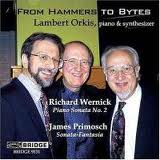 I knew the Kurz, like any other synth, would start to become obsolete the day I drove it off the lot, so to speak, and the more I took advantage of the capabilities of that particular synth, the more I increased the difficulty of playing the piece with some other keyboard. I very much wanted to write the piece for Lambert, but I also wanted to come out of the process with something that other musicians could play. I eventually devised a plan where a portion of the Sonata-Fantasia could, with some adjustments, live again as a solo piano piece. The first movement of the piece is a big set of variations, running about 25 minutes, and that became the now-published Piano Variations.
Lambert wanted me to think about the history of the piano while writing my piece. (You should know that in addition to being an astounding pianist, best known as Anne-Sophie Mutter’s recital partner, Lambert has an interest in historical keyboards, and has played and recorded on various old instruments, or modern reconstructions modeled on old keyboards.) We talked about the ability of the Kurzweil to emulate the sound of historic keyboards, and Lambert tracked down a set of impressive fortepiano samples. (One curious issue arose - when using the fortepiano samples, should I employ notes that are not actually on the fortepiano keyboard? I wrote in two different versions for that moment, one with bass notes lower than any fortepiano can play, one that sticks to the instrument’s actual range.) The stock harpsichord sample in the Kurz was attractive as well. Most of the Kurzweil patches I used are synth sounds of one kind or another, many percussive, some more atmospheric, and some used to modify the attack and decay characteristics of the acoustic piano. But given those samples of early keyboards, it was a short step from there to writing variations that would invoke earlier keyboard idioms - not earlier harmonic or melodic styles, but more matters of keyboard layout and texture. The harmony and melody in my piece remains rooted in the materials in my theme (see the score samples mentioned above), but, for example, there is a variation using a harpsichord patch that is laid out like one of the Goldberg Variations - two voices in canon and a third free voice. The fortepiano variation invokes one of the Schubert impromptus - this in honor of Lambert’s recording of the Schubert on fortepiano. (I permit myself the only actual quotation from an already existing piece in that movement.) The climactic variation has passages modeled fairly closely on the Chopin C-sharp minor etude from Op. 10, and there are other references throughout the piece to Chopin, Messiaen, stride piano, and even the 19th century pianist/composer Kalkbrenner, with a passage that employs his “three-handed” layout: a melody played by the thumbs surrounded by two-handed arpeggios. Contemporary composers are also in the background of some of the variations, with hints of textures you might associate with the music of three of my mentors: George Crumb, Richard Wernick, and Mario Davidovsky. The piece thus becomes not just variations on a theme, but a collection of varied approaches to the piano itself.
Practically speaking, the synth and piano are arranged at right angles to one another, in the manner of a piano/celesta doubling by an orchestral keyboardist. (Lambert is the principal keyboard for the National Symphony.) Lambert preferred this to the stacking of keyboards that pop performers sometimes prefer, since that arrangement puts significant restraints on conventional piano technique. I had Lambert switch back and forth between instruments a good bit, sometimes playing both keyboards at once. Since the synth was at the left of the piano, this meant there are a few passages where Lambert’s left hand was playing in a high register on the Kurz and his right hand in a low register on the Steinway - perfectly plausible, but seemingly impractical when you look in the score, since it appears the left hand is playing five or six octaves above the right! I remember checking with Lambert repeatedly to make sure we were in agreement about which side the synthesizer would be placed.*
I prepared the piano version of the movement in time for a 50th birthday concert of my music a few years ago, and the superb Stephen Gosling gave the first performance. I finally (thanks to Ken) got around to preparing a clean copy of the score more recently, and the result is there on Presser’s website. Thank you, Lambert, for commissioning the original version of the piece, and thanks to the MacDowell Colony, where a big chunk of the first movement was devised.
I will return to writing for piano in an upcoming consortium commission, about which more soon.
*) I didn’t want to run into the problem I once heard conductor Arthur Weisberg describe in connection with a performance of the Carter Double Concerto, where, before the first rehearsal, he carefully prepared the beat patterns he would need for the closing portion of the piece where the two portions of the ensemble are in different meters. He was startled when he arrived at rehearsal to realize the ensembles were on the opposite sides of the stage from what he expected.
Recent listening - quick takes
A few items, new and old, that I have enjoyed recently:
 Thomas Adès: Tevot, Violin Concerto, Three Studies from Couperin, Dances from Powder Her Face. The first two pieces are major statements. Tevot - the name means “ark” or a musical measure - is a big single movement orchestra piece, thickly layered, recalling Ligeti in its density; the concerto is of necessity more lightly scored. Both pieces share some of the same interests in repeated, layered cycles - both have memorable slowly descending quasi-tonal chord progressions - not unlike the infinitely unfolding slow music in Adès’ Asyla. The “non-tonal” or “quasi-tonal” successions of tonal chords recall some of the modal effects of Vaughan Williams, of all people, as well as some of John Adams’s preferred harmonies. Probably the neo-Riemannian harmonic analysis that has been in vogue for a bit (identifying compositional strategies that change just a note or two when moving from chord to chord) would work well on these passages in Adès.
 Miles Davis: “Four” and More. Classic live material from 1964, with George Coleman, Herbie Hancock, Ron Carter and Tony Williams (only 18 at the time). Davis and his colleagues were done a disservice by whoever compiled so many insanely fast pieces into a single album. It is pretty hard to take straight through, but in smaller doses it is astonishing. I especially liked the energetic and constantly varied work of Williams. He is a very active player, but there is an airborne quality to the sound he gets from his set that keeps his playing from being overwhelming.
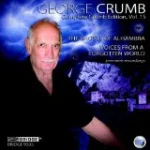 George Crumb: The Ghosts of the Alhambra, Voices From a Forgotten World. Volume 15 in the Complete Crumb Edition being issued by Bridge Records offers two vocal pieces. Alhambra returns to Crumb’s beloved Lorca, in settings for baritone, guitar and percussion, while Forgotten World is the fifth in Crumb’s cycle of American Songbooks, arrangements of traditional American tunes for voice (in this case, baritone Patrick Mason and mezzo Jamie Van Eyck) and a percussion orchestra manned by four players, plus amplified piano. Members of Orchestra 2001, led by James Freeman, are old hands at Crumb’s music, and the performances are superb. In the last stanza of the last song, “The Demon Lover”, the mezzo sings “And what hills, what hills are those, my love, Those hills so dark and low? and the baritone replies, “Those are the hills of Hell my love, Where you and I must go.” Crumb’s setting is appropriately disturbing and profoundly creepy.
Columbus Day Miscellany
- Cassatt Quartet plays Sebastian Currier, Mari Kimura, and Judith Shatin at Symphony Space, Thursday, October 13 at 7:30. Works feature live electronics and digital projections.
- nice to see Bridge Records get some attention in the NY Times today. Bridge’s contribution to the field is tremendous.
- and something goofy for no good reason (the visuals are superfluous, although I suppose they will identify a few characters for you).
Rainy Day (again) Miscellany
Posting has been sparse thanks to the day job, family duties, and attempts to compose. But here are a few items:
- Mindy Wagner‘s Trombone Concerto is out on Bridge Records. This is an important release of music that truly deserves to be much more widely known. I hope to write more about this release soon.
- Do the Math has posted what adds up to a small book on Bud Powell, with many transcriptions and plenty of commentary.
- Guitarist Dan Lippel plays Davidovksy, Carter, Dai Fujikura, Richard BelCastro and more at Delaware County Community College in Media, PA on Sunday, October 2 at 3:00
- Curtis Opera Theater is presenting Miss Donnithorne’s Maggot by Peter Maxwell Davies with soprano Anna Davidson in the title role. It has been a while since I saw the superb Christine Schadeberg do the piece, but I recall it as quite a tour de force. A dramatic cantata of Handel completes the evening. Performances are October 6 through the 9th at 7:30 at the Curtis Institute.
- The only Pulitzer Prize winning composer to perform with both Miles Davis and Toscanini has written his autobiography, coming out next month.
- Chopin and Liszt star in the webcomic Hark, a Vagrant. (Perhaps a companion to Strauss and Mahler at the movies.)
The Name of the Game
 I was speaking with a composer colleague a number of years ago, and remarked that the music of Richard Wernick is exceptionally under-appreciated. My friend thought for a moment, then replied, with some vehemence, “we’re all under-appreciated!” Well, that’s true, but more than some, Wernick’s music truly does deserve wider recognition and performance.
Not that he has been lacking for first-class advocates. The opening piece on Bridge’s most recent CD of his music is a horn quintet performed by no less than William Purvis and the Juilliard Quartet. The flavor of the harmony and the bustling texture of the work’s opening suggest Schoenberg, although frankly Wernick’s harmony makes more sense to my ear than that of the earlier master. Furthermore, the contrasting quieter sections in Wernick’s music have a stillness and meditative repose (though never static) that is foreign to Schoenberg’s expressive palette. I remember reading a record review years ago about Wernick’s first piano sonata, (recorded by Lambert Orkis for Bridge) in which the reviewer connected Wernick’s music with that of Morton Feldman. That reviewer was way off target, as Wernick is vitally interested in the meaningful pattern making that Feldman seems to studiously avoid. Rather than Feldman, I connect Wernick’s most inward moments with the crystalline slow movements that are sometimes found in the music of Ralph Shapey; I know Wernick admired the older composer’s work tremendously,
The CD also offers the Colorado Quartet playing Wernick’s Sixth Quartet. This is darkly intense music, as befits its impetus: a memorial work for a cousin of Wernick named Henry Levy who worked for forty years as a field executive for the American Jewish Joint Distribution Committee. According to Wernick’s program note, Henry Levy was an extraordinary man, unstinting in his service to Jewish refugees from both Nazi and Communist regimes. Even after his retirement, Levy continued to support Jewish causes financially and eventually left the bulk of his assets to universities in Israel. Wernick honors this remarkable individual with a tightly focussed single movement work, entirely derived from a powerful unison opening.
The last major work on the disc, The Name of the Game, is for guitar and 11 players. David Starobin, creator of Bridge Records, is the featured soloist in this piece, originally written for Philadelphia’s Network for New Music, and here performed by the International Contemporary Ensemble (ICE), with Cliff Colnot conducting. Starobin is responsible for encouraging hundreds of composers (including Crumb, Carter, Davidovsky, Rouders, Foss, Schuller and Babbitt) to create new works with guitar, and Wernick honors him in a time-hallowed manner by deriving his musical material from the letters of Starobin’s name that correspond to musical pitches: D; A; vi; D; S (German “es”); and so forth. Starobin’s performance is typically virtuosic, full of varied colors, and Wernick draws a similarly kaleidoscopic array of sounds from the ensemble. Two short solo works played by Starobin round out the disc.
Although the charming picture on the cover of this CD shows Wernick tossing sheet music to the wind, he is not interested in randomly scattering notes - rather, what Richard Wernick accomplishes, through painstaking craft and deeply expressive intensity, is to give his music flight.
