Tuesday evening miscellany

-I have finally gotten around to reading Terry Teachout’s biography of Louis Armstrong, Pops. It truly does deserve all the accolades it received when it came out last year. The book is full of fresh insights buttressed by fresh research, all couched in elegant prose.

-Yes, I know the proper way to learn jazz repertoire is by studying the recordings - but for those of us who need a little help, there are transcriptions. I am enjoying reading the Fats Waller transcriptions in Paul Posnak’s collection of piano solo pieces, although enjoyable is not exactly the word for trying to reach some of Waller’s widely spaced left hand voicings. Perhaps I need some help of this kind.

-Dr. Guthrie Ramsey’s blog is now including posts by the professor of MusiQology himself, in addition to an archive of student contributions mentioned here previously. Dig the videos he has posted, including some Cab Calloway. He also found footage of the Nicholas Brothers together with Michael Jackson (I would not have guessed they were alive at the same time.) Congrats, Guy, on co-curating the Apollo Theatre exhibit which recently opened at the Smithsonian’s National Museum of African American History and Culture.

-I have been meaning to write about these discs for a while now, and I do want to post about them in more detail, but let me give a quick mention here of Miranda Cuckson’s superb discs of violin music by Ralph Shapey and Donald Martino. Fascinating repertoire, commanding performances. Much more to say, coming soon.

Crumb’s American Songbooks

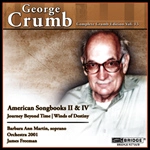
George Crumb is a quintessentially American composer - to my mind, ranking with Ives and Copland. Wildly popular in the 1970’s, Crumb’s stock fell a bit in the 1980’s, though I think his popularity overseas did not wane as much as here in the states. Crumb has experienced a late-in-life creative blossoming, in some ways comparable to that of Elliott Carter, two decades older than Crumb. Carter was extraordinarily productive in his 90s, and during the same period, Crumb was similarly productive in his 70s, finding in American folksong a rich compositional resource. The result has been a series of American Songbooks, now grown to six substantial sets. In these, Crumb has arranged folksongs, spirituals, and other traditional tunes, either for solo voice, or two singers, accompanied by percussion quartet and piano. The medium is perfect for Crumb, with his exquisite ear for instrumental color and preference for long ringing sounds. Each set uses an extraordinarily large complement of instruments, including various non-western ones. (The works would surely be more widely known if the instrumental resources required were not so great.) The piano, as the composer has remarked, serves as a bass for the percussion ensemble which it would otherwise lack.

The pieces have been written with Philadelphia’s Orchestra 2001 in mind (see a relevant video clip at their website), and the group’s performances, led by its artistic director James Freeman, are exemplary. The first four of the Songbooks have been recorded for Bridge Records, with Barbara Ann Martin, and the composer’s own daughter Ann Crumb as the superb soloists. (Find Songbooks II and IV on disc here; Books I and III here.) The Bridge releases are part of a their “Complete Crumb Edition”, an admirable commitment to documenting the work of a true American treasure.

Pulitzer Grammar

Monday’s announcement of the Pulitzer Prize in music (warm congratulations, Jennifer!) inspired me to pull out the CD that won the 2007 prize for Ornette Coleman: Sound Grammar.

I was struck by how tuneful the album is, even to the point of quoting other melodies. There are certainly plenty of edgy moments here, but if you only know Coleman from Intro to Jazz class, where he is the token scary, inscrutable avant-gardiste, this record presents a rather different picture. Listen to the hauntingly folk-like, archaic quality of Sleep Talking,  a meditation on the opening notes of Rite of Spring. Who do you think of as a saxophonist who would quote “Beautiful Dreamer” and “If I Loved You” in a blues solo? Maybe Dexter Gordon? how about Ornette Coleman?

The instrumentation of the album - Coleman is accompanied by two basses and drums - seems odd, but the two basses actually work out better than one might expect. Usually one is playing arco, the other pizz. The high register arco bass serves as another frontline instrument, often sounding in the alto sax register. The harmonic specificity of a keyboard or guitar would unhelpfully tie down Coleman’s pitch language, and the absence of a chordal instrument gives more sonic space for the two basses.

I posted a while back about the treatment of rhythm on Vijay Iyer’s Historicity - Coleman’s approach can be similarly rich. A common strategy here is to have pizz bass and drums playing at a furious tempo while Coleman lopes along at a more moderate speed, not precisely half time, but still feeling right.

Sometimes Coleman’s flexible treatment of intonation is merely gamey instead of expressive. And the last track on the album includes a freakout section for the two basses that overstays its welcome. But I can see why this disc won a major award.

===============

update: read Jennifer Higdon’s remarkably gracious comments about the Pulitzer here.

Tatum on Proper

Listening to the florid pianism of Art Tatum can be like eating rich chocolate truffles - you start to appreciate his records less than you should after the first half-dozen or so. But you don’t get that effect with parts of the Proper Records Tatum anthology because of the variety of contexts in which Tatum can be heard. The third disc in the Proper set begins with an item from a jam session recorded at the Metropolitan Opera House in 1944. Here Tatum is on good behavior, providing a tasteful accompaniment to a richly textured Coleman Hawkins reading of My Ideal. Next up is a series of trio recordings, with Tiny Grimes on guitar and Slam Stewart offering his charming simultaneously sung and bowed bass solos. (Did Stewart sing and play his solos just so that he would have a better chance of being heard on disc?) Parts of these performances are clearly pre-arranged ensembles, though they are intended to sound spontaneous - it makes me wonder just how spontaneous some of the solo work is as well. Given Tatum’s partial reliance on stereotypical piano figuration, the whole question of what is improvisation and what is not starts to become a gray area. The disc also includes the deservedly famous solo recordings from 1949 - Willow Weep for Me, Aunt Hagar’s Blues, and more. But there is also a rather bizarre live track, also from 1949. Tatum Pole Boogie hardly sounds like Tatum at all. The piece is in a down-home boogie-woogie idiom, like something Meade Lux Lewis might play. But the playing is rushed and, dare I say it, sloppy - instead of the usual solid and rounded Tatum sound, the runs are garbled, as though the pianist’s fingers were only skimming the surface of the keys. There are two spots where the continuity almost breaks down. It is thrilling in its way, but very atypical for Tatum.

Billy Collins Suite

I’ve been enjoying listening to a recent release from Cedille Records, featuring works inspired by the poetry of Billy Collins. The disc is titled The Billy Collins Suite, and the CD cover describes the contents as “songs inspired by his poetry”, but both of those concepts are a little far-fetched - these pieces, by five different composers, are really independent works, and not all of them are truly songs.  Pierre Jalbert’s The Invention of the Saxophone, is scored for narrator, saxophone and piano, but could work just as well if not better as a powerful purely instrumental sax and piano fantasia.* The Collins poem read by the narrator serves merely as a sort of program note, a meditation on the nature of “saxophone-ness”.

Among the actual songs on the disc are the pieces that make up Stacy Garrop’s contribution, a cycle called Ars Poetica, scored for mezzo and piano trio, and full of imaginative and dramatic musical imagery. I like the way this set encompasses such a wide variety of harmony - there are many shades of light and dark here.

While the Jalbert and Garrop pieces are musically very compelling, they may be too vivid for the poetry at hand. Setting Collins is no easy task. Both Garrop and Jalbert trade in direct, clear, passionate musical gestures; but Collins’s strategies are sly, indirect, oblique, even though he is known for being an accessible poet. Expressive depth in the poetry lies some distance from the often whimsical surface, while musical expression is direct and immediate in Garrop’s and Jalbert’s compositions. Jalbert’s piece is more passionate than anything in the Collins poem from which it takes off. I am not saying that the Jalbert and Garrop pieces are superficial - simply that the music’s expressive temperature is hotter than that of the poetry, and a certain formal dissonance results.

Pieces by Vivian Fung, Lita Grier, and Zhou Tian round out the disc, and the performances are uniformly fine. Would that Philadelphia had its version of Cedille Records, with an organization like the Chicago Classical Recording Foundation behind it.

*) I am reminded of the time I sat next to a senior colleague at a performance of Schoenberg’s Ode to Napoleon for narrator and piano quintet. Halfway through, my colleague leaned over and remarked that he wished the narrator would shut up so he could hear the piece. By the way, Jalbert is a fellow winner of a recently announced award from the American Academy of Arts and Letters.