- The NY Times has a blog by composers.
- my friend Peter Hoyt has a piece on Stravinsky at the Mostly Mozart website. I think the Stravinsky/Picasso angle is especially interesting.
- Something silly for the holiday.
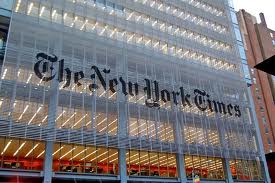 Hey, I’m in the New York Times!
Or at least some guy with a very similar name is.
Back in 1993, Alex Ross gave me a favorable review in the Times - and spelled my name Primrosch.
Today, Steve Smith gave me a positive review in the Times - and spelled my name Primrosch. (Update: the Steve Smith review has been corrected - thank you for arranging this, Steve. I’ve also inquired about the 1993 error.)
Over the years, I have cashed checks made out to Primrosch, Primrose, and Primosh, among others. I am told the name was probably originally Hungarian, and would have been spelled Primocz, Primosch being a Germanization. I have also been told more than once that the “primocz” is the first violinist in a gypsy band, though you can’t find evidence of that on Google. I once had a driver’s license with the name Prbdsch. It did not go well when I explained to a traffic cop “oh, that’s not really my name”.
In case it is too much effort to click the link above, here is the relevant portion of today’s review:
The Prism Quartet — the saxophonists Timothy McAllister, Zachary Shemon, Matthew Levy and Taimur Sullivan — focused on music from a newly released Innova CD, “Dedication.” Initially envisioned as a collection of 20 one-minute pieces to mark the group’s 20th anniversary in 2004, the project overflowed its boundaries: the CD offers 25 pieces by 23 composers. The concert, around an hour long, included 24 works, mostly complete.
Given the intended format, most of the pieces were clever bagatelles based on a single notion: rhythmic intricacy, smooth blend, extended vocabulary and so on. Still, you were repeatedly surprised by just how much personality could be expressed in a few deft strokes, through the lush harmonies of Greg Osby’s “Prism #1 (Refraction)”; the 24-tone giddiness of Frank J. Oteri’s “Fair and Balanced”; the crabby grandeur of Tim Berne’s “Brokelyn”; and the jazzy swagger of James Primrosch’s “Straight Up,” to name just four examples from a consistently engaging program.
Prism Quartet performs again Friday at Leonard Nimoy Thalia, Symphony Space, 2537 Broadway, at 95th Street; (212) 864-5400, symphonyspace.org.
- Mimi Stillman has posted video of Dolce Suono’s performance of Songs of a Wayfarer, with Eric Owens.
- Soho the Dog has an apropos comic strip.
- New York Philharmonic “Focus on Mahler” page.
- Mahler makes the Times Op-Ed page.
David Lang on baseball and new music. (via Joy Howard.)
What does it say about our musical culture that James Oestreich can write the following in a spring preview piece in the Times about a festival of visiting orchestras at Carnegie Hall:
Though top-rank orchestras are eligible, few American behemoths have yet shown interest. But the Montreal Symphony is here with Kent Nagano leading a program tracing the evolution of the symphony, from Gabrieli brass works and Bach sinfonias to Beethoven’s Fifth. Jaap van Zweden leads the Dallas Symphony in a work it commissioned for the Lyndon B. Johnson centenary in 2008, “August 4, 1964.”
The other orchestras for the inaugural season are the Albany Symphony (with an evening of reimagined spirituals), the Toledo Symphony, the Oregon Symphony, the St. Paul Chamber Orchestra and the Orpheus Chamber Orchestra of New York. All tickets are $25.
and fail to mention the name of the composer of “August 4, 1964”? This is not some five-minute curtain raiser, but a well-received evening-length oratorio by Pulitzer Prize winner Steven Stucky. (I give you a quote of that length so that you can see the context.) It was even Oestreich who reviewed the piece for the Times.
I am reminded of the newspaper picture of the entire company bowing after a performance of Richard Danielpour’s opera “Margaret Garner” a few years ago. The caption identified everyone in the picture except Richard.
Lawrence Downes, in a NY Times piece celebrating the 50th anniversary of the admirable Arhoolie Rrecords writes about the wonderful range of music heard on that label:
If it was homegrown and honest Mr. Strachwitz found it, captured it and shared it.
Well, no, actually. There are plenty of other “homegrown” and “honest” musics that are outside the purview of Arhoolie - unless they have released anything by Ives or Copland, Carter or Adams, Reich or Singleton, Harbison or Tower, or…
The social construction of “homegrown”, “honest” or other words like “authenticity” always seems to exclude the homegrown, honest, and authentic creations of America’s composers.
New fiction, new plays - publishers and theaters present the new without apology, it is expected that new work will be offered to the public and that not all of it will be superb. The galleries in Chelsea offer the latest work, people would complain if they didn’t, and not all of it is great. And yet, Allan Kozinn’s recent Times article talks about how musicians have to apologize for the fact that not every new piece is a masterpiece. Why should this even be an issue? The fact that not every new piece is immortal does not mean the presentation of new music has to be justified, any more than the publishing of new fiction.
Perhaps one reason why the new is welcome and expected in writing and the visual arts but not in non-pop music is that there is money to be made in books and in the visual arts (at least in the upper echelons of those fields) - and relatively little money changes hands in the world of new music. So how could new music be worthwhile? Since what my mother always sarcastically called the “almighty dollar” is America’s principal means of validation, new art is naturally considered important, and pop music is considered more “vital” than non-pop. The supposed vitality of pop music has nothing to do with music but rather with the invigorating scent of money.
Jon Pareles comes close to admitting it in this article: that dumb pop music is in fact boring because it is not well composed, something many of us non-pop types knew all along. Radiohead’s “Creep” is (slightly) interesting not because of Thom Yorke’s persona, but because of how it is composed: because of the B major chord that follows the opening G major - suggesting a secondary dominant, but not playing out that way; or because of the gunshot-like burst of distorted guitar (a sound that will dominate the refrain) that enters before the quiet verse is fully over, a tiny bit of dovetailing that enriches the formal shape.
It takes a composer, not a “producer”. That’s a funny word. At one time, the producer in the pop realm was someone who acted as an intermediary between the artist and the engineer, separate from the arranger, who actually created aspects of the musical content. (Frank de Vol arranged for Nat King Cole, he was not the producer of Cole’s records.) These days, the arranger has disappeared, and the producer is doing things that are more arranger-like. However, the musical content has more to do with the timbre of a synth, whether a sampled piano will be panned hard right, or whether to apply a slap-back delay to the guitar. The producer is arranging, but arranging is less like what the performing artist does, and more like what the engineer does.
I wonder what I am hearing when a Penn undergrad business major speaks of how she is interested in “music production”. Do she mean counting sixteenth notes or counting royalty checks? “Producer” has, of course, an echo of “mass production”, or “industrial product”, which is what all too much of pop music is about.
 It has been several years since the New York Times stopped using the labels marking off classical and pop music articles in the Arts and Leisure section. Fine, far be it from me to figure out what heading is appropriate for a given type of music. But if everything is to be considered under the general label “Music”, why are classical CD reviews segregated into their own irregularly appearing section? Why are there never any classical CDs in the “critics’s choice” listings that appear every week in both the daily and Sunday editions? Why is classical music marginalized? Why is inclusivity the goal except when it comes to one of the musics I love?
