Upcoming in Philly and elsewhere

-There will be two more workshop sessions on Paul Moravec’s new opera Danse Russe this weekend, one in Delaware, one in Philly. Details here, video on Danse Russe here.

-The Buffalo Philharmonic is presenting works by emerging composers (not yet identified in the announcement I received) on its February New Music Festival.

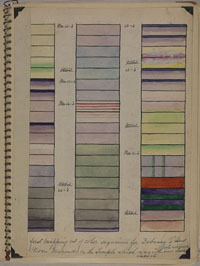
- Thursday January 27, the Historical Society of Pennsylvania here in Philadelphia will present a program of music inspired by the Society’s collection of materials relating to Mary Elizabeth Hallock Greenewalt, an eccentric Philadelphia inventor and musician. According to the Society:

“Greenewalt developed an art form that she called “nourathar,” which uses an organ to display colored light scored to music using her own custom notation system. The image (at left) shows Greenewalt’s mapping color sequence for Claude Debussy’s “And the Moon Descends on the Temple That Was.” In order to fulfill her musical pursuits, Greenewalt entered the engineering world and was awarded several patents. In the 1930s, she spent much of her time in court, suing others for patent infringement. The Historical Society of Pennsylvania holds extensive records on Greenewalt’s life.”

Music by Andrea Clearfield, Willhem Echevarria, Ted Houghtaling, Max Lawrence and Maurice Wright will be heard; more info here.

Dropped My Popsicle

Mr. Goldman played “Finlandia” with such feeling and attention to tonal detail that I dropped my Popsicle, and the lady alongside me, who was about to reach the bottom of her Cracker Jack box, held off searching for her prize until the end of the piece.

That is from a 1949 New Yorker review of a Goldman Band performance in Central Park, written by Philip Hamburger. I have associated that name with the The New Yorker for some time, but did not know Hamburger served as music critic for the magazine for a year until I read Friends Talking in the Night, an anthology of Hamburger’s sixty years of writing for The New Yorker. I highly recommend the volume, not just for the examples of music criticism, but for the widely varied writing on all manner of topics.

Although not a musician, Hamburger’s writing about music is sensitive and thoughtful, lively and engaged. He is interested in new music, commenting approvingly on a Koussevitzky program with the BSO that included works by Foss, Schuman, Cowell, Barber, and Piston (with all the composers present). He is also uncommonly funny.

There is very little than can be said about the opening opera [at the Met in 1948]. There is a good deal to be said about the Opera Opening.

-“Otello,”  Maybe (December 1948)

I’m afraid Miss Pons has reached a point, operatically, where she should be seen and not heard. She was admirably decorative, but when it came to the singing – well, let’s talk about network time and package deals.

-Mostly Positive (December 1948)

The rest of the program was scarcely more satisfying. Mr. Münch gave us Lalo’s overture to “le Roi d’Ys, ” which, as far as I’m concerned, could be renamed “The Ride of the Rockettes”.

-Hark (January 1949)

Mr. Berglun sang Jokanaan, the Prophet, with superb dedication, but physically he was so detached and immobile that I felt matters had changed hardly at all when the Prophet’s head was served up, toward the close of the ceremonies, on a platter… Miss Thorborg, as the cold-blooded mother of Salome, was adequately depraved.

-Minority Report (1949)

There are also interesting tidbits to be picked up by reading reviews from 60 years ago. Who would have thought that Britten’s “The Rape of Lucretia” was produced at the Ziegfeld Theatre in New York in 1949, with the role of Lucretia taken by… Kitty Carlisle???
Saturday Doubleheader

It was a musical doubleheader in New York for me last Saturday as I attended both the Met matinee and the NY Phil in the evening.

I am not a big Puccini fan, (even though I cry at Bohème) but I was very impressed by Fanciulla, the last performance of the run at the Met. This was a strong cast, especially Deborah Voigt.  She sounded great, singing with both power and beauty of sound. The range of expressive types Minnie has to project is remarkable: she is playful, steely, vulnerable, kind, heroic, and Voigt conveyed them all. The theme of the piece is Wagnerian - a man redeemed through a woman’s love - but this time the woman survives to get her man, not just redeem him. Alex Ross smartly observes how Minnie beats the men in the piece at their own games (both literally - a poker game - and figuratively) “and then breaks down their macho codes”. The first and third acts end in a remarkably low key manner, with the ambiguities of the final curtain nicely summarized in the figure of the sheriff, left alone on stage, handling a gun, still wanting to kill the tenor, but unable to move. Ross found fault with the production, and it is on the literal side, at once a bit stiff and very busy. Voigt remarks in an interview how she has to handle tons of props in this staging. She seems to spend a long time in the first act putting away whiskey glasses. I suppose this is necessary given the amount of drinking that goes on - per capita at about at the level of an Albee play.

In the evening I heard two men named Thomas - Hampson’s Kindertotenlieder was deeply affecting, and Adés played his piano concerto with video, a collaboration with Tal Rosner. I am an Adés fan, but I was not consistently held by this piece. Anthony Tommasini’s review makes the music sound much more varied than it seemed to me. Too much of the work involved streams of regular durations, often layered against similar streams moving at slightly different speeds, but still lacking in sufficiently characterized rhythmic profile. Still, there was much to admire when the rhythms were less static. I found the video was at its most compelling when most dense, with various geometric patterns intricately overlaid. However, there were also brief moments that were dangerously close to screensaver images, or the visualizer in iTunes, or even the abstractions that accompany the Bach toccata and fugue in Disney’s Fantasia.  I appreciated the fact that the music and image were closely coordinated. I always hated the way the jump cuts from frantic activity to stasis in the Godfrey Reggio/Philip Glass collaboration Koyaanisqatsi are not quite in sync, but that is not the case here.

Update: hear the Adés on Instant Encore here.

And More New Links

- My Penn colleague Jay Reise has a new website with the usual array of composerly info, including audio clips. Handsome design by Jonas Music Services.

- Philly trumpeter Bart Miltenberger is blogging at Outside Pants.

- Of the many worthwhile blogs at Arts Journal, I have been spending enjoyable time with Doug Ramsey’s Rifftides lately. He has a knack for finding tasty video clips.

Music for Food and more upcoming in Boston

- Pamela Frank, Kim Kashkashian, Ahrim Kim, Dimitri Murrath, Tom Novak, Robin Scott are the performers at Music for Food, a concert to benefit the Greater Boston Food Bank - January 7 at 6:00 pm, Emmanuel Church, 15 Newbury Street Boston.

- BMOP offers Tippet, Rosenblum, Meltzer and Paulus at Jordan Hall, January 22.

- Collage New Music plays Mazzoli, Liptak, Lerdahl, and Boykin, January 24, at the Longy School.

The Voice of Bartok

I never knew a recording of Bartok speaking in English existed till I came across this today, thanks to a link at Pytheas Music’s “Composers Speak” page. There are tons of new music links of many kinds at Pytheas; the collection is rather indiscriminate, some items are rather more interesting than others, and there are some dead links as well. But still definitely worth visiting. (Thanks to Kile Smith for the tip on this.)

No Apologies

New fiction, new plays - publishers and theaters present the new without apology, it is expected that new work will be offered to the public and that not all of it will be superb. The galleries in Chelsea offer the latest work, people would complain if they didn’t, and not all of it is great. And yet, Allan Kozinn’s recent Times article talks about how musicians have to apologize for the fact that not every new piece is a masterpiece. Why should this even be an issue? The fact that not every new piece is immortal does not mean the presentation of new music has to be justified, any more than the publishing of new fiction.

Perhaps one reason why the new is welcome and expected in writing and the visual arts but not in non-pop music is that there is money to be made in books and in the visual arts (at least in the upper echelons of those fields) - and relatively little money changes hands in the world of new music. So how could new music be worthwhile? Since what my mother always sarcastically called the “almighty dollar” is America’s principal means of validation, new art is naturally considered important, and pop music is considered more “vital” than non-pop. The supposed vitality of pop music has nothing to do with music but rather with the invigorating scent of money.

It Takes a Composer

Jon Pareles comes close to admitting it in this article: that dumb pop music is in fact boring because it is not well composed, something many of us non-pop types knew all along. Radiohead’s “Creep” is (slightly) interesting not because of Thom Yorke’s persona, but because of how it is composed: because of  the B major chord that follows the opening G major - suggesting a secondary dominant, but not playing out that way; or because of the gunshot-like burst of distorted guitar (a sound that will dominate the refrain) that enters before the quiet verse is fully over, a tiny bit of dovetailing that enriches the formal shape.

It takes a composer, not a “producer”. That’s a funny word. At one time, the producer in the pop realm was someone who acted as an intermediary between the artist and the engineer, separate from the arranger, who actually created aspects of the musical content. (Frank de Vol arranged for Nat King Cole, he was not the producer of Cole’s records.) These days, the arranger has disappeared, and the producer is doing things that are more arranger-like. However, the musical content has more to do with the timbre of a synth, whether a sampled piano will be panned hard right, or whether to apply a slap-back delay to the guitar. The producer is arranging, but arranging is less like what the performing artist does, and more like what the engineer does.

I wonder what I am hearing when a Penn undergrad business major speaks of how she is interested in “music production”. Do she mean counting sixteenth notes or counting royalty checks? “Producer” has, of course, an echo of “mass production”, or “industrial product”, which is what all too much of pop music is about.