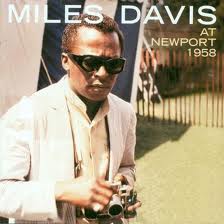
 Miles Davis at Newport 1958 might be called the “anti-Kind of Blue“. The two discs share personnel - Davis, Adderly, Coltrane, Evans and Chambers play on both records, Cobb on Newport, Philly Joe Jones on Kind of Blue. But apart from personnel the records are remarkably dissimilar. Kind of Blue was made in the studio and, even apart from being hallowed by time and hype, seems “perfect”: beautifully recorded; stocked with eloquent solos without dead spots or clams; impeccably swinging and profoundly moody. Newport 1958 is live, and not especially well recorded (the bass and piano are nearly lost at times.) The front line sounds a bit confused given the crazily fast tempo of the opening Ah-Leu-Cha. Coltrane’s solos seem far more exploratory and willful on this record than on Kind of Blue, despite the latter record coming after the Newport performance. I like the relaxed swing of Straight, No Chaser and appreciate a chance to hear a second version of Bye Bye Blackbird, one that is less tightly bound to the melody compared with the Round About Midnight version. There is a rough and ready quality to the Newport set that is very different from the melancholy haze of much of Kind of Blue. I value both records, but for very different reasons.
Month: November 2010
Post-turkey Miscellany
- Congratulations to my friend Peter Hoyt on the NY Times coverage of his research on Mozart’s debts.
- violist Vincent Royer plays John Cage, Gyorgy Ligeti, Tristan Murail, Horatiu Radulescu, and Giacinto Scelsi at Slought Foundation in Philly on December 10.
- New Yorker literary critic James Wood writes about Who drummer Keith Moon. A keyword search of the mind of a prominent literary critic using the search terms “edgy drummer 1960’s” yields the result “keith moon” rather than, for example, “elvin jones”. What does this say about the place of music in the culture at large?
Composers Talking
Alex Ross in Philly
The podcast for Alex Ross’s recent talk at the Free Library of Philadelphia can be found here. (Via Kile Smith)
Recent and Upcoming Listening
Recent Listening:
Eleanor Cory - Of Mere Being (CRI) and Chasing Time (Albany): attractive lines capable of blossoming floridly; compelling, jazz-tinged harmonies; convincing forms; superb performances.
Upcoming Listening:
Daniel Asia - Purer Than Purest Pure (Summit): choral works, with BBC Singers conducted by Odaline de la Martinez.
Andrew Rindfleisch - Night Singing (Innova): performances by Zeitgeist, including improvisations by the composer.
Morris Rosenzweig - Home and Away (Albany): music for varied ensembles in performances by the New York New Music Ensemble, Canyonlands, NOVA, and members of the Utah Symphony
Ode to a Cecelian Book
 This being the feast of St. Cecelia, I want to call your attention to a book by my now retired colleague Thomas Connolly. Mourning into Joy: Music, Raphael & St. Cecelia investigates the layers of meaning in the story of St. Cecelia, touching on music, interpretation of scripture, art history, and much more. If you have ever wondered why the portative organ with which Cecelia is often depicted has its pipes arranged in the wrong direction, this is the book for you. (No, I hadn’t noticed it before reading this book either.) Elegantly written and beautifully produced, the book has much to offer readers interested in music or religion or both.
By the way, the Raphael seen above is an example of a sacra conversazione. (Note third item down on the linked page. NYNME plays Merkin tonight.)
Bartok in NYC and Philadelphia
Thanks to Alex Ross, and via Opera Chic, I checked out the video where Esa-Pekka explains the story of Bluebeard’s Castle to the L.A. Phil. But I want to call your attention to one of the videos that came up when the Bluebeard one was over - Esa-Pekka on Bartok in NYC. Very moving. He visits Columbia U. to check out Bartok’s papers which they have thanks to his ethnomusicological work there.
I recall there being a bust of Bartok in the Columbia Music Library on the top floor of Dodge Hall. My understanding is that Jack Beeson was a pupil of Bartok - the only American to study with him. I wish I had talked to Jack about this.
There are more Bartok papers here in Philly. The U of PA library has the papers of the Musical Fund Society of Philadelphia, and Bartok’s 3rd Quartet won a composition contest the Society sponsored. Consequently, Penn has an autograph of the Bartok 3rd. Bartok shared the prize with… Alfredo Casella.
Mehldau at Carnegie
Except in the few movements where the strings hold the spotlight, or where the woodwinds and horns elaborate briefly on a theme, the orchestral scoring is secondary, and for long stretches the St. Paul musicians sat silently.
-Allen Kozinn in the New York Times on the premiere of Brad Mehldau’s Highway Rider for jazz ensemble and orchestra.
I am quite certain that Brad Mehldau is one of the very top jazz pianists active today. I am less certain that he is the very top choice of composer to be given opportunities to write for Renee Fleming, Anne Sophie von Otter, or the St. Paul Chamber Orchestra, and to be composer-in-residence at Carnegie Hall. It’s not that jazz artists shouldn’t be allowed sully the holy institution of The Orchestra with their grimy hands. That’s just dumb. But it does seem odd for Mehldau to have opportunities of this stature.
I look forward to, say, John Harbison, or Augusta Read Thomas being offered a commission by Jazz at Lincoln Center. More about Renee Fleming here.
Crumb’s Songbooks in LA, NYC, Ojai
 Delia Casadei has a fine piece on George Crumb in the LA Times. It is especially nice to see the Songbooks getting such high profile performances, particularly by Upshaw and Hampson. (Nothing against Tony Arnold, who is quite fabulous and deserves the kind of recognition Upshaw and Hampson have achieved.) Dawn has narrowed down her list of composers a bit in recent years (as I know all too well), good to see George is still on that list. And Hampson’s advocacy of American music has tended toward more conservative composers.
It will be interesting to see what Sellars does in staging the pieces. A performance of one of these Songbooks involves a huge array of percussion that is already quite arresting, visually; I don’t know the Ojai stage, but I wonder how much room there will be - literally and psychically - for a staging.
I previously posted about George’s American Songbooks here. (photo: Peggy Peterson/Bridge Records)
Soon in Philly and NYC
-The music of seven members of the Philadelphia chapter of the American Composers Forum - Efrain Amaya, Michael Djupstrom, Daniel Shapiro, Adam B. Silverman, Tony Solitro, Thomas Whitman, and Ya-Jhu Yang - may be heard as part of a new music theater piece on the Decameron, tonight and through the weekend at the Prince Music Theater in Philadelphia.
- Network for New Music’s November 21 program is called Trade Winds from Tibet and presents music by Andrea Clearfield springing from her research gathering songs in Tibet; composers Eric Moe, Tony Solitro, Michael Djupstrom are also featured.
-The Contemporary Chamber Ensemble of SUNY Stony Brook presents its annual concert of premieres - Nov. 17 on campus, Nov, 18 at Merkin Concert Hall. New music by David Cutler, Leo Kraft, Laura Schwendinger, Daria Semegan and Ken Ueno.
- New York New Music Ensemble offers music of Eric Moe, Keeril Makan, Caroline Malonée, Kati Agócs, and Stephen Hartke, November 22 at Merkin.
 James Primosch, composer