Now Again

Network for New Music has released an all-Bernard Rands cd entitled Now Again, featuring the fabulous mezzo Janice Felty and the superb Network for New Music Ensemble. Read more about it and purchase a copy  here. Also, check out Network’s videos, including one on recording the Rands disc, as well as the first in a series of “Summer Shorts”, this one featuring Penn grad student composer Melissa Dunphy - yes, she of Gonzales Cantata fame.

I haven’t yet heard the disc, but I was at the first performance of the title work, which is based on Sappho fragments. It is an uncommonly gorgeous piece.

Learning this cursed role

Two footnotes to Alex Ross’s post about a chord progression accompanying operatic curses in Wagner and Strauss:

- to me, the rising arpeggiation of both examples cited by Ross recalls the similar gesture in the fourth scene of Rheingold when Alberich puts a curse on the ring - though in that example the melody falls at the end of the phrase.

- Ross points toward an online archive with images of the parts for Die Feen, Wagner’s first opera. See an example here. What startled me about this was that the singers learned their parts not from a vocal score as we would understand it - an arrangement of the orchestral accompaniment for piano - but just a bass line along with their own vocal line. But for the lack of figures, it looks like a baroque aria. I don’t know Die Feen, but I doubt that the harmony is as tricky throughout as it is in the passage Ross cites. Still, it can’t have been easy for a singer to learn his or her part without knowing the details of what was going on harmonically in the accompaniment. Maybe scholars have already worked on this, but it seems to me this is an area of performance practice that merits further investigation. Can you imagine learning Tristan or Gurnemanz with only a bass line as reference? (Perhaps another reason the first Tristan, Ludwig Schnorr (I love that name) dropped dead shortly after the premiere.) On the other hand, while I assume there were piano rehearsals with a fuller accompaniment, can you imagine hand-copying the piano accompaniment for a Wagner opera for each soloist? Were there engraved performance materials for the first performances of the later Wagner operas?

Ritual Fragments

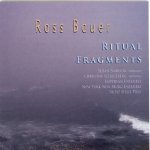
I’ve been enjoying a disc from a few years back featuring music of Ross Bauer and entitled Ritual Fragments. Released on Albany in 2007, the album includes five pieces from the 1990s, both vocal and instrumental. Performances are exemplary, with top soloists and ensembles: singers Christine Schadeberg and Susan Narucki, the New York New Music Ensemble, the Triple Helix (the Boston-based piano trio) and Ross’s own Empyrian Ensemble, in residence at UC Davis, where he teaches. Ross works in a post-tonal language, and the musical surface can shift rapidly, even kaleidoscopically - either via juxtaposition, or through magical transmutations smoothly shifting from one instrument to the next. But, as David Rakowski comments in his booklet notes, “there’s always a long line unfolding underneath”. I was struck by how Ross integrates motoric and non-pulsed rhythms, and admired the care with which he paces the rate of harmonic change.  The vocal pieces both set texts by indigenous peoples - Eskimos and Native Americans. Ross’s command of a wide range of mood and color lets him find apt frameworks for these varied and evocative texts. I hope more music of Ross Bauer - perhaps including some more recent pieces - finds its way to disc soon.

Sandow on Pulitzer

So Greg Sandow in a series of recent posts (here’s the first) wants to know why the Pulitzer prize never goes to pop music, fending off arguments by saying you aren’t on the same planet as he if you don’t think, for example, Bob Dylan represents some of the best in American music. Personally, I hardly think of Bob Dylan as a musician at all, but that’s my bias. When I set aside that bias for a moment, I, of course, recognize Dylan, and all the other folks Sandow mentions, as terrifically important figures who are the very best at what they do, and I love the work of some of them. But what they do is too different from what classical musicians do to throw them all into the same pool. To invoke the cliche, we really are talking about apples and oranges here, or maybe apples and pine trees. How could you possibly pick between, say, Lucinda Williams and Peter Lieberson? You don’t make the swimmers and the marathon runners compete against each other at the Olympics, right? To really give a broader spectrum of music its due we would need more than one award. How to divide it up? Notated and non-notated? (with jazz on either side of the fence?) Best score and best recording?

With one prize, the consequence of including pop will be to make the prize reflect the marginal place of classical music in the wider culture. Exactly why is that a good thing?

By the way, Sandow is not quite right about none of the finalists in recent years coming from outside the classical realm. Don Byron (2009) is best known as a jazz musician, John Zorn (2000) is beyond category, but is certainly not part of the classical world the way other finalists are, and it could be argued that Elliot Goldenthal (2007) is better known as a composer of film scores than for his classical pieces.

Remembering and forgetting Varèse

The Lincoln Center Varèse concerts are this week; Alex Ross has various links and video of Varèse as a silent film actor. (I’m afraid I found the ICE theatrical trailer pretty dopey.)

These concerts remind me of being a student at Columbia at the time of the Varese centennial, and, as we were all Chou Wen-Chung students, being roped into working on an all-Varese concert. There was a panel discussion earlier in the day - all these elderly folks, I think Otto Luening and Meyer Schapiro among them - reminiscing about Varèse. Or, actually, talking about all kinds of things except Varèse. (The panel was called “Remembering Varèse”, but fellow student Paul Moravec referred to it as ‘Forgetting Varèse”.) The climax of the panel was when it was time for Varèse’s widow Louise to speak. Finally, we thought, this will be the real thing, the profound insight, the key to understanding the man and the artist. Louise leaned toward the microphone and said:
“There was never a dull moment.”
And that was all she said.
I notice that the Lincoln Center programs omit one very rare piece. Varèse actually composed three electronic works - everybody knows the Poéme and Deserts, but he also did some electronic music for a film by Thomas Bouchard called Around and About Joan Miro. The music was for a portion of the film called Procession at Verges. I only know about this because we projected the relevant portion of the film at that all-Varese concert at Columbia, along with some home movies of Varèse talking with Carl Ruggles. Ruggles sounded like Jimmy Cagney playing a gangster (“I thought Walt Whitman was the greatest American poet, see?”) while Varèse sounded like, well, like somebody doing an imitation of a cosmopolitan boulevardier.
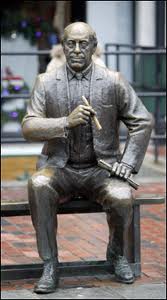
(The image above is of Calder’s wire sculpture of Varese)

Tempestuous broadcast and streaming

My Songs and Dances from ‘The Tempest’ will be heard on Kile Smith’s program Now is the Time this coming Sunday, July 18th at 10:00 pm Eastern Daylight Savings Time. The piece was commissioned by the Folger Consort, the early music ensemble in residence at the Folger Library. Soprano Ellen Hargis and baritone William Sharp sing settings of excerpts from Shakespeare’s “The Tempest”, alongside instrumental movements suggested by stage directions in the play. Christopher Kendall, Robert Eisenstein, Scott Reiss, and Tina Chancey are the superb multi-instrumentalists.

You can listen to the program on WRTI-HD2 in Philadelphia and streaming on the web at WRTI.org.  An excerpt from the piece is on the audio samples page of my website, jamesprimosch.com, and the CD from which the recording comes is available here.