The Call

I am writing this as a break from working on a new motet for Emmanuel Church, the latest in a series of pieces I have made over the last two decades for that remarkable community and its remarkable musical traditions. The text is a George Herbert poem, the same one that Vaughan Williams used in the Five Mystical Songs:

The Call

Come, my Way, my Truth, my Life:
Such a Way, as gives us breath:
Such a Truth, as ends all strife:
Such a Life, as killeth death.

Come, my Light, my Feast, my Strength:
Such a Light, as shows a feast:
Such a Feast, as mends in length:
Such a Strength, as makes his guest.

Come, my Joy, my Love, my Heart:
Such a Joy, as none can move:
Such a Love, as none can part:
Such a Heart, as joyes in love.

I believe my colleague Carson Cooman has set the text as well. I am sure there must be other composers who have been attracted to the lapidary quality of this poem.

I am working a little differently from my customary process of keeping one eye on the text while composing and taking the form of the poem as a compositional constraint. Here I find myself – at least in portions of the piece – working out the musical shapes first, then fitting text to those shapes. Of course, the musical motifs were first suggested by the rhythms and inflections of the poem, but I am letting musical considerations determine how long a section goes or what dramatic contour it projects, rather than the piece being fundamentally text-driven. I wouldn’t call it a deconstruction; what I am doing is rather more mild-mannered than that. But I can’t recall when I have treated a poem in quite such a non-linear manner. It’s a way of breaking free of a tightly circumscribed poetic form, I suppose.

If I finish this soon enough, it will be heard at the Sunday Eucharist of Emmanuel Church, Boston, on January 26. Time to get back to work.
The Icebox and The Crossing

I am happy to report that I have received a commission from the extraordinary chamber choir The Crossing, to compose a work to be premiered in the performance space called The Icebox, part of the Crane Arts Building here in Philadelphia.

Here is what I wrote about my proposed piece in my application to the commission competition:

In describing the Crane Icebox space, the competition guidelines refer to it as an “industrial cathedral.” This suggested to me a work that would reflect both the cathedral-like qualities of the space as well as the paradox inherent in the juxtaposition of those two terms. I propose a work that will set portions of the traditional Latin texts for the Mass alongside excerpts from Denise Levertov’s cycle of poems “Mass for the Day of St. Thomas Didymus”. Levertov’s choice to refer to the apostle known as “doubting Thomas” in her cycle’s title reflects the struggles of her own faith journey. “Industrial cathedral”, with its suggestion of human effort set alongside divine possibility strikes me as resonating with the figure of St. Thomas, whose story in the Gospel brings together both the skeptical and the faith-filled.

My proposed work will call for a small group of singers, perhaps three or four, to function as a schola, singing the traditional Latin Mass texts using a musical vocabulary that evokes plainchant but in a modern harmonic idiom; something ritualistic, austere, stylized. This schola will be placed at one side of the Icebox space, while the main body of the choir will be positioned at another side, and will sing the Levertov texts in a more dramatic and expansive idiom, though motivically related to the music for the Latin settings. The possibilities for choral antiphony are obvious. At times the groups will simply be contrasted, at other times they may be more dramatically juxtaposed, with the schola being heard amidst openings in the larger choral texture, or with the larger group providing a contemplative sonic space in which the schola can perform its rituals.

I am very excited to be working on this. Although I have written a number of short motets (and am presently trying to finish another one for a January premiere at Emmanuel Church), this piece is the biggest unaccompanied choral work I will have attempted. The premiere will be June 28, 2014.

Gatsby Videos

Go here for a substantial set of videos featuring Emmanuel Music’s Ryan Turner, along with John Harbison and Richard Dyer discussing John’s The Great Gatsby, to be performed by Emmanuel in Boston’s Jordan Hall this coming Sunday, May 12. Of particular interest in the videos are segments where John and Ryan perform excerpts from the piece, illustrating how the same motives and harmonies can be heard in both the synthetic period pop songs and in the main body of the work.

The Albany Symphony’s performance of a suite from The Great Gatsby as part of Carnegie Hall’s Spring for Music festival is tomorrow night, May 7 - tickets here.

Gatsby Returns

Judging from what you can hear on the trailer, you won’t be going to the upcoming film of The Great Gatsby for the music. Seekers of a musical Gatsby should be getting their tickets for the Boston premiere of John Harbison’s opera on the subject, being given by Emmanuel Music in a concert version featuring the the full orchestration.*  This will take place at Jordan Hall on Sunday, May 12.

A few days before the Boston performance you can preview some of the music from the opera in a May 7 Carnegie Hall concert by the Albany Symphony, with David Alan Miller conducting. The program will include a suite from Harbison’s work, alongside music by Gershwin and Morton Gould. This is part of Carnegie’s Spring for Music festival of orchestral concerts.

It is nearly inexplicable to me that Harbison’s opera was not more universally praised on its first appearance. I say “nearly” because the tempi of conductor James Levine did make the piece lose momentum at moments, leading critics to interpret a performance flaw as a compositional one. There was certainly plenty of praise for the piece, as the quotes on G. Schirmer’s web page confirm. But apart from Bernard Holland’s despicably condescending take, most of the reviews mix admiration with niggling at details, or vague reservations. Alex Ross didn’t care of the setting of Gatsby’s first entrance, with a long note on the first word of “I’m Gatsby.” What did he want, a long note on the first syllable of “Gatsby”? You’d have something akin to the current fad of goat vocalism on YouTube. Mark Swed remarks that “Harbison may have solved too many problems.” He would prefer that the piece have unsolved problems? It’s hard to know what that means, given that Swed goes on to describe how the composer succeeds in creating a dramatic narrative. I was amused to read how Holland and Swed had precisely opposite opinions on the staging and design of the production.

Listening to the piece again on the recording issued by the Met as part of a James Levine 40th anniversary CD collection, one thing that struck me, besides Levine’s tendency to drag the pacing at moments, was how poorly the chorus sounds, singing the synthetic 20’s pop songs with an unpleasantly and totally inappropriate heavy vibrato. (I’m sure Emmanuel won’t have that problem.) Still, the performances by the all-star cast (Upshaw, Hadley, Hunt-Lieberson, Graham) make up for these deficiencies. It’s good to have the recording because repeated listenings confirm that the piece is musically substantive in a way that few post-war operas are. There is a real composer at work here, folks - maybe the problem with the reception of the piece is that listeners to contemporary opera aren’t accustomed to that.

* In an earlier version of this post, I had assumed that the chamber orchestra version (prepared for a production in San Francisco) was being done. Apologies to Emmanuel Music for the error!

In Memoriam Mary Ruth Ray

UV01I was very sorry to hear today that Mary Ruth Ray, violist of the Lydian String Quartet and a performer with Emmanuel Music, has died of cancer at the age of 56. There is an article here from Brandeis where she taught and chaired the music department. (Note the slideshow link - some great pictures.)

The Lyds over the years have made a terrific contribution to new music. I’m familiar with their fine recordings of music by Harbison, Mackey, and Hyla, and I experienced their excellence myself several years ago when they performed my 2nd Quartet. I didn’t know Mary Ruth well, but in that performance of my quartet, and in observing her work with Emmanuel, I gained a sense of her quiet excellence.

Fifty-six, my own age. And two In Memoriam posts in a row. (photo credit: Mike Lovett)

UPDATE: Boston Globe obit here.


Rejoicing Resounding

I’m on the Acela after a fine brunch with Emmanuel Church friends Ryan Turner and Pat Krol - this after the service at which my Gaudete in Domino was premiered. As I expected, the choir did a great job.  By calling for a slightly earlier rehearsal time before the service  than usual, Ryan (the group’s conductor) got the ensemble some extra time to touch on various details of my piece. Ryan knows what he wants - a slightly different emphasis in the text, a warmer sound here, a lighter sound there - and knows how to ask for it; the choir, in turn, knows how to respond to his requests, and does so with skill and with abundant good will. The congregation at Emmanuel is uniquely trained to listen intently, having listened to weekly Bach cantatas and other great stuff for years. So they are uncommonly receptive to my music, often responding with unusually insightful comments. One gentleman this morning remarked on my setting of the words “Dominus prope est”  - the Lord is at hand. He noted that the customary reading of this line associates it with the imminent arrival of the Lord at the end of time (the scripture texts for Advent have an apocalyptic side). My setting - pianissimo, warmly harmonized, low in register - represented another reading: a sense of calm assurance about the Lord’s presence here and now.

Emmanuel Church is indeed a place where the Lord’s presence can be felt - a place where the hidden wholeness of which Thomas Merton wrote breaks into our lives. I’ll say it again: for this I am deeply grateful.

Emmanuel Music’s website here, Facebook page here.

update: My shots from Sunday’s rehearsal mostly didn’t come out well - just this one seems worth sharing:

IMG_2370 copy

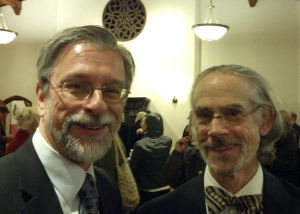
update #2: Emmanuel parishioner Elizabeth Richardson was kind enough to pass along a picture taken at the post-Eucharist gathering for hospitality. Here I am (on the left) with parishioner Michael Scanlon (I dig the bowtie, Michael. There were some nice ones among the choir members as well.)

James Primosch & Micheal Scanlon

The Crossing in Philly and NYC

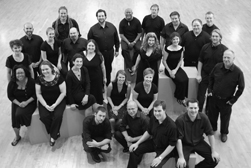
the_crossing_2010_smIt is a lucky month for me with respect to my choral music. I’ve already posted about how Emmanuel Music will do a new motet this coming Sunday; but in addition, The Crossing, Philadelphia’s extraordinary choir devoted to the music of our time, will do my Spiralling Ecstatically at concerts in Philadelphia and New York in the days before Christmas. Donald Nally will conduct.

The Philadelphia performance will be Friday, December 21, at St. Paul’s Episcopal Church in Chestnut Hill at 8:00 pm. Go here for more information and to get tickets. I just learned today that the group will also do the piece when they perform at the Metropolitan Museum of Art in New York on December 23. This will take place in the Medieval Sculpture Hall in front of the Christmas Tree and 18th-century Neapolitan crèche at 6:30 pm. More information here. (The Crossing’s page about this concert has not yet been updated to include mention of my piece.)

Both Emmanuel and The Crossing are quite superb, and I am looking forward to some great performances.

(Photo of The Crossing.)

Rejoicing is Complete

I finished the motet I mentioned in my last post, Gaudete in Domino (Rejoice in the Lord). The first performance will come up very soon: it will be done at the 10 am Sunday Eucharist at Emmanuel Church in Boston on December 16. Ryan Turner will conduct. The choir of Emmanuel Music is quite fantastic - the church is renowned for performing a Bach cantata in the context of the Eucharist each Sunday. BWV 136, Erforsche mich, Gott, und erfahre mein Herz, will be done on the 16th.

Gaudete is the seventh in a series of motets I have written for Emmanuel since 1994, and you can read more about my experiences with Emmanuel here and here, among other posts. The group can do pretty much anything I throw at them, and do it beautifully.

Here’s how the piece starts:

gaudete


Mid-Hiatus Miscellany

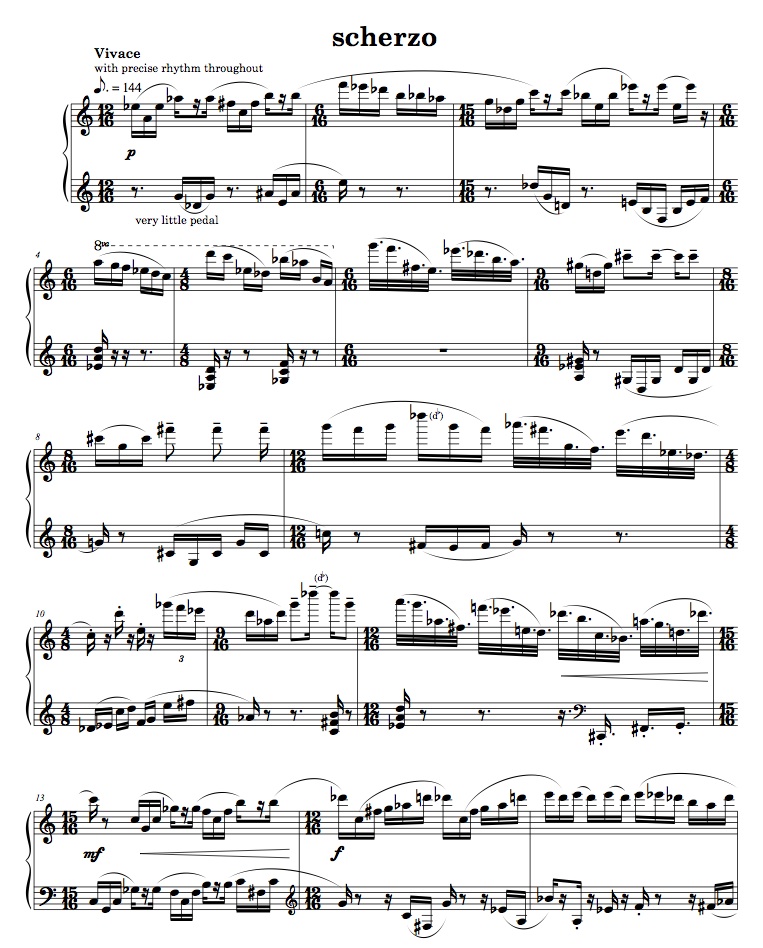
- Two of the projected five movements of my piano consortium piece are now complete. I showed you a bit of one movement here, and here is an excerpt from the other movement:

As with the previous fragment, this still needs some editing of the notation, but it will give you a little taste of the piece. Will comment on it in another post. I want to replace the tired name “Scherzo”, but no idea yet what it might eventually get called.

- If you like words (hey, you’re reading something, so I guess that might include you), you might find these as interesting as I do.

-regarding some Boston friends:  Cantata Singers is offering Bach, Brahms, Zelenka, Marjorie Merryman, and James MacMillan, among others during the coming season. In addition to the usual Bach Cantatas, Emmanuel Music is doing the Bach Christmas Oratorio, and the Boston premiere of Harbison’s The Great Gatsby. I assume this will be done in the recent “pocket version” that Jacques Desjardins re-orchestrated, rather than the original version done at the Met.

-Here in Philly, Orchestra 2001 is offering an all-Cage program and a collaboration with Pifarro, the Renaissance Wind Band this coming season.

Second Performance Syndrome

I have written elsewhere about the problem of the second performance - the difficulty of getting a piece performed more than once. Now there is an article on the Chorus America website about the issue, with a few intriguing observations, most notably Libby Larsen‘s comments about how repeat performances seem to come more easily in the realm of choral music than instrumental. My own experience doesn’t quite bear that out. I have been lucky to get my choral music performed by fine groups, and my Denise Levertov cantata, Fire-Memory/River-Memory, has been done twice by its commissioning organization, Philadelphia’s Mendelssohn Club - in fact, a recording of their second performance of the piece has recently come out. But only one of my half dozen or so motets has been done by a group other than the one it was written for. (All but one were composed for Emmanuel Music, with the exception being performed at St. Jean Baptiste Church in NYC.) Matins, my Cantata Singers commission, awaits a second performance. Yes, I’ve been lucky, but I’d like a little more luck, please. What to do?

Well, for a start, a listing of my choral music, with score samples and audio clips, is here.