Dogs of Desire (Report from Albany #2)

Final rehearsal for Luminism went well today, with yesterday’s adjustments falling into place very nicely. This was the first time I heard the piece all the way through, and therefore my first chance to really assess the formal shape. I think it is going to work, though there is a lot of slow music.

After a fine dinner at Muza, a Polish restaurant in Troy (a sampler with pierogis, stuffed cabbage and potato pancakes was excellent; the Polish beer, called Zywiec, well, nothing special), my colleagues John Harbison, Stacy Garrop, and I went to hear the Albany Symphony’s new music ensemble, called Dogs of Desire. The Dogs are a unique endeavor, in that they have a relatively set chamber orchestra instrumentation, and that they play only newly commissioned works written for the group. The aesthetic angle is downtown-ish, with pop elements, including arrangements of familiar tunes, yet the group is not easily pinned down. I see George Tsontakis and Paul Moravec on their list of commissioned composers, alongside Marc Mellitts, David Lang, and Caleb Burhans. My favorite pieces tonight were a new work by Todd Reynolds involving Eric Singer’s musical robots (midi-ed acoustic instruments - some of the same instruments that Pat Matheny has been touring with); Ted Hearne’s setting of a Frank O’Hara poem; and, as an encore, an arrangement of the Bruce Springsteen song Fire (you know it from the Pointer Sisters version) by Derek Bermel. David Alan Miller conducted very fine performances, though amplified chamber orchestra remains tricky with respect to balances: the strings were occasionally reduced to mimes.

Report from Albany

No, this is not a post about New York’s famously dysfunctional state legislature. I’m talking about the Albany Symphony’s American Music Festival this weekend. I am here for the premiere of a commissioned work, Luminism, and there will be music by Stacy Garrop and John Harbison as well. Read more here, including comments from Albany music director David Alan Miller. I heard a rehearsal of my piece Tuesday evening - the orchestra is sounding very fine. I sent David a lengthy list of requests and suggestions, including two spots where I want to make more than just an adjustment in dynamics - adding a few notes to the contrabass part, and changing the register of the ending. It is late in the game to be making substantive adjustments like that, but David works very efficiently, so I am hopeful we can get everything implemented at tonight’s rehearsal. One challenge is that the stage at RPI’s new EMPAC is a little small - the hall sounds and looks great, but the musicians - in particular the percussionists - are a little crowded.

I was not in Albany yesterday, but in NYC for the American Academy of Arts and Letters Ceremonial. It is a singular experience to be on a stage with Meryl Streep, James Levine, John Ashberry, Michael Graves, Hal Holbrook, Bill Moyers, Garrison Keillor, Marilynne Robinson, Edward Albee, etc., etc. - not to mention my composer colleagues…

Luminism

Later this month, I will be traveling to Albany for the premiere of my new orchestral piece, Luminism, to be played by the Albany Symphony, led by David Alan Miller. This is part of the Albany’s American Music Festival, and the program will include music by John Harbison, Stacy Garrop, and Einojuhani Rautavaara. The concert takes place at EMPAC, a performing arts center on the campus of Rensselaer Polytechnic Institute.

Here is my program note for the piece:

=-=-=-=-=-=-=-=-=-=-=-=-=

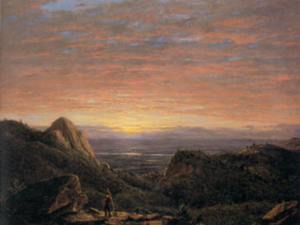
When David Alan Miller invited me to compose a new work for the Albany Symphony, he asked me to consider writing a piece inspired by the paintings of the Hudson River School, the so-called Luminist painters. As I got to know the work of such painters as Thomas Cole, Albert Bierstadt, Frederic Edwin Church, and others, I took pleasure in their intense and sumptuous effects of light as it illuminates varied landscapes. I noticed how these painters explored the light of different times of day – dawn, moonlight, day, sunset. My work does not reflect on specific paintings, but is a meditation on the various forms of light throughout the day, as conveyed in Luminist painting. The piece is framed by passages that suggest the absence of light: I needed night to make day glow more intensely.

=-=-=-=-=-=-=-=-=-=-=-=-=

The Albany Symphony is playing very well these days - just listen to some of their numerous recordings. I am very much looking forward to reuniting with David (our first encounter goes back to a New York Youth Symphony premiere in 1987) and with the Albany Symphony (they premiered my Some Glad Mystery in 1992).

The image above at left is Morning, Looking East Over the Hudson Valley from the Catskill Mountains by Frederic Edwin Church, from the collection of the Albany Institute of History and Art.

Diabolic Diabelli

Now that my piece for the Albany Symphony, “Luminism“, is in the capable hands of Ken Godel, who is computer engraving the score, I can turn my attention to the next project: a contribution to a collection of 25 variations by 25 composers on the theme of Beethoven’s  Diabelli Variations (click on the image at left for an IMSLP link to the score of the Beethoven) to be premiered at the 25th anniversary celebration of Network for New Music here in Philadelphia. The event takes place at the Queen Street branch of the Settlement Music School in Philly, on May 2. Go here to see the list of composers involved; the styles represented are nicely diverse. The title of this post is the title of my piece, and comes from the fact that I have re-imagined the harmony of the theme using stacks of tritones, the good ol’ diabolus in musica, as the theorists tell us.