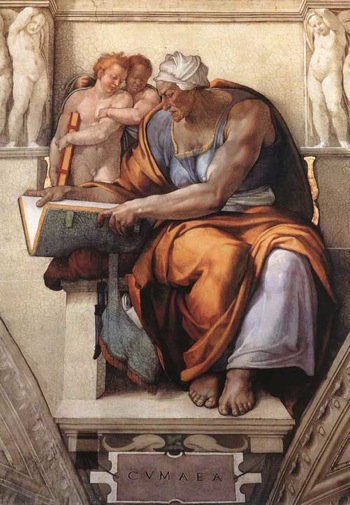
the Sibyl of Cumae in the Sistine Chapel
Written on a Fromm Foundation commission, A Sibyl is a cycle of six songs on texts by Susan Stewart, whose poetry I have set in several other pieces - Holy the Firm, Dark the Star, and Songs for Adam. Susan wrote the poems specifically for this new project. Collage New Music will premiere the piece at the Longy School in Cambridge, MA on October 15, 2017 at 3 pm. (There will be a pre-concert chat at 2 pm.) Mary Mackenzie will be the soprano soloist and David Hoose will conduct. Here’s my program note on the piece:
When I asked my friend Susan Stewart to write a set of poems for a new work for soprano, she responded with reflections on the mysterious prophetess spoken of in Virgil and Ovid. The sibyl sings of her prophecies written on leaves, and of how the god possesses her; she warns Aeneas before his descent to the underworld; she celebrates the moon. Having been granted eternal life, but failing to ask for eternal youth, she is reduced to no more than her voice. I understand the sibyl as an archetype of the musician who sings for us of fate and the mysteries of life, death, and love; who guides us in moonlit and shadowy places; and whose prophetic voice resounds unendingly, in power, and in vulnerability.
A Sibyl was written for Collage New Music on a commission from the Fromm Music Foundation. I am grateful to the Foundation, to Collage, and to Mary Mackenzie for making this work possible, and to Susan Stewart for words to sing.
Mary has performed many pieces of mine, and she recorded Sacred Songs and Meditations with the 21st Century Consort, led by Christopher Kendall.
She has also recorded a big 2-CD collection of songs by various composers with pianist Heidi Williams that will include four pieces of mine, to be released on Albany later this season.
Collage Fellow Joseph Sowa published an interview with me on the Collage website - I talk there about working with Susan’s poetry and my history with Collage.

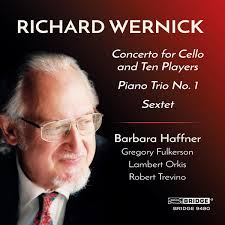 Richard Wernick: Sextet; Concerto for Cello and Ten Players; Piano Trio No. 1. Bridge Records 9480. Here are three masterfully crafted and powerfully expressive works from an exceptionally underappreciated American composer. (I say “exceptionally” because, as the late Steve Stucky once said to me, “we’re all underappreciated!”) Richly contrapuntal, the music is in a dissonant post-tonal idiom, finding coherence in its focussed use of striking motifs and economical harmonic vocabulary. The pitch language is nicely balanced between consistency and variety. When I was in the grad program at Penn, Wernick used to exhort my fellow students and I to “make your own tonality!” He does so in his own music and succeeds brilliantly.
 I just got word that the fabulous duo of soprano
 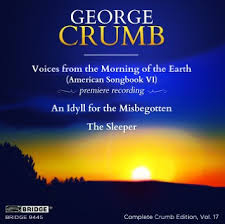 Complete George Crumb Edition, Volume 17: Voices from the Morning of the Earth (American Songbook VI); An Idyll for the Misbegotten; The Sleeper. Bridge Records 9445. George Crumb’s profoundly American compositional voice is perfectly suited to the tunes and texts that form the basis of his huge American Songbook cycle, based on folk tunes of all kinds (plus a couple of folk-like tunes of his own devising) and scored for one or two solo voices, percussion quartet, and amplified piano. Philadelphia’s Orchestra 2001, led by James Freeman, has this repertoire deep in its bones, and all of Crumb’s meticulously detailed effects are realized with exquisite care. While baritone Randall Scarlata sings with affecting beauty, it’s the composer’s daughter Ann Crumb who is even more captivating with her highly characterful singing. Ann and pianist Marcantonio Barone offer a reading of Crumb’s Poe setting, The Sleeper that is full of misty atmosphere, and flutist Rachel Rudich, alongside three percussionists, is eloquent in the Idyll. It was surely no simple matter to capture for recording both the barely discernible rumbles and tremendous bass drum thwacks of this piece. The uncommonly wide dynamic range of Crumb’s music benefits greatly from the capabilities of digital sound.
 Fingering remains a mystery to me - I often don’t realize when I am doing something unnecessarily awkward, or don’t see what could be a viable alternative. The cliché about the easiest fingering not necessarily being the best fingering is not terribly helpful when “easiest” and “best” seem to be moving targets that shift from day to day. Pianistic issues aside, engaging with pieces by playing them is essential nourishment for me - as a composer, but also as a person, and I was glad to have a little more time for that nourishment over this past summer.
 Haydn: Piano Sonatas II - Marc-André Hamelin. Hyperion.
 All Rise - Jason Moran. Blue Note.