Extreme Measures

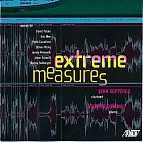
I have a piece on Jean Kopperud’s new CD, Extreme Measures, which has just hit the streets. Working with pianist Stephen Gosling, Jean commissioned seven new pieces for clarinet and piano, toured with them, and recorded them for Albany. The original intent was for the seven relatively short pieces to fit on a single CD, but Harvey Sollberger was unexpectedly generous with the length of his piece, and the music is now issued as a two CD set. Besides myself and Harvey, the other composers represented are Paolo Cavallone, Jason EckardtDavid Felder, Eric Moe,  and Steven Ricks. David’s piece includes electronic sound, and is interesting formally in that the four parts of the piece are interspersed among the other works, serving to frame the program. My own contribution is called Times Like These. You can hear a short excerpt of the piece at my website. I was interested in writing a piece with a lot of short but linked movements, having tried that with the nine songs that make up my cycle for baritone and chamber ensemble, Dark the Star. I had intended for Jean’s piece to include more than the five movements I ended up with, but  given the amount of time the material needed to unfold, no more than five sections would fit in the seven-minute length Jean had requested.

The piece starts with soft, slowly moving clarinet lines, microtonally inflected, and laid over clustery piano chords. Things gradually expand in register and activity, until exploding into more disjunct, percussive gestures that die away and lead to the 2nd part. Here, a paper clip attached to a piano string, combined with some muted high notes, creates a gentle gamelan like effect, the piano alternately with liquid low register clarinet phrases. There are debts to Messiaen and Crumb in this section. Part three is a perpetual motion piece, with scalar licks articulating pulse units that quickly vary in length. The fourth section returns to a strategy I have employed in some earlier pieces, going back to Secret Geometry for piano and tape, and Sacra Conversazione for chamber ensemble and tape. The idea is to gradually increase the density over the course of the movement by adding additional layers of counterpoint over previously heard music. In this case, there is a section for piano alone, for clarinet alone, and then those same  two get fitted together. It’s an old strategy by no means confined to classical music - here’s a very clear example by Irving Berlin - the layers combine at about 2:30. (classical treatments of this device - opera ensembles, for example - are infrequently so straightforward). The texture of this fourth section is disjunct, even pointillistic, with piano writing that is indebted to the Martino of the Fantasies and Impromptus. The fifth section begins with the percussive chords and jagged clarinet licks that ended the first part, returns to the more sustained music of the very opening, and the piece ends with a reprise of the gamelan music.

That’s a lot of description - my formal program note for the piece forgoes this for something more distanced:

These five brief studies, played without pause, embody challenging times in their mercurial rhythms. I wrote these with confidence in the extraordinary virtuosity of Jean Kopperud and Stephen Gosling, the players who would bring the piece to life.  But any piece involves multiple contexts, more than just the framework created by its performers. How much the work is about the times of the music and how much about the music of the times I leave for the listener to decide.

The reference here is to the last portion of the George W. era, and the horrors of that period are surely reflected in the character of some of the music.

Jean and Steve offer dazzling performances throughout the album, and there are excellent contributions from  a variety of composers. My favorites were Eric Moe’s Grand Prismatic and Jason Eckhardt’s Rendition (a double-meaning title that also refers to the “music of the times”), but there is much worth hearing in every piece. The incomparable Judith Sherman produced and engineered the disc. I am proud to be a part of this project. Jean has set up a second round of commissions, this time for clarinet and percussion - will let you know when I hear more about this.
Swiss (Ellington) Movement

I came upon this disc at a branch of the Free Library here in Philly. (Thank God for libraries and librarians. But what made somebody order this particular fairly obscure disc?) It documents a live performance by the Ellington band in Zurich in 1950, and it is fascinating to hear the band roughly mid-way between the Blanton-Webster masterpieces and the famous Newport appearance. The best thing about this Zurich disc is the solo work, rather than the compositions, although there are interesting things in that regard as well. I enjoyed Harry Carney, too infrequently in the spotlight, playing Strayhorn’s “Paradise”, and Johnny Hodges with his own Strayhorn showcase, “Violet Blue”. Strayhorn himself comes to center stage for a moment, with a solo turn on ” ‘A’ Train”. Among Duke’s own compositions on the album, “The Tatooed Bride” is the most extended, with some intricately layered writing, including some amazingly  pointillistic transitions. But in general there is a loose quality about this concert, with some of the tunes rather casually put together. I don’t know how it came to be, but Don Byas is a guest, and has an excellent solo on “How High the Moon”. Ernie Royal has a similar feature on a standard tune, with some choruses of “S’Wonderful”. The recorded sound is quite decent for the time and for a live performance, though balances are not always ideal. It is not clear to me why, but the band is carrying two drummers - Sonny Greer and Butch Ballard. Duke makes reference to them both in his remarks after “Bride” - it is not clear if they are alternating or if they sometimes play together - it doesn’t sound like more than one at a time. What did strike me is that  the drumming is sometimes heavy handed throughout the disc - accents boom through the texture annoyingly - perhaps a combination of the performer and the PA system? The booklet notes for the disc are almost unintelligible, and there are some interesting typos (the noted Italian trombonist “Quentini Jackson” makes an appearance). This is not in my top five Ellington albums, but anything by Duke is of interest, and you might want to check this out.

Alban ‘n’ Franz

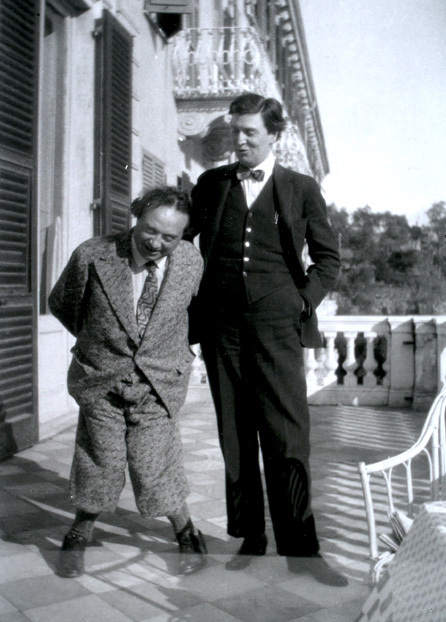
In honor of the Berg festival happening up at Bard this month, here is a picture of Alban with writer Franz Werfel, third husband of Alma Schindler Mahler Gropius Werfel (This may be helpful if you are already confused.) The image comes from the UPenn library, which happens to possess Alma’s papers. Alban, the tall fellow, appears to be saying something, but what could it be? My best guesses:

1) Are those handcuffs too tight for you, Franz?

2) Are you really knock-kneed, or is it the suit that makes you look that way?

3) Franz, you’ve got your knickers in a knot again! Ah, well, Alma does that to men.

4) I understand you were much taller before you met Alma.

Separate, not separate, still not equal

It has been several years since the New York Times stopped using the labels marking off classical and pop music articles in the Arts and Leisure section. Fine, far be it from me to figure out what heading is appropriate for a given type of music. But if everything is to be considered under the general label “Music”, why are classical CD reviews segregated into their own irregularly appearing section? Why are there never any classical CDs in the “critics’s choice”  listings that appear every week in both the daily and Sunday editions? Why is classical music marginalized? Why is inclusivity the goal except when it comes to one of the musics I love?

Chick Corea in Carolina

University of South Carolina Professor Bert Ligon has an excellent page with links to lots of jazz transcriptions, many by himself, and (I am guessing) some by his students. A highlight is a version of Coltrane’s “Giant Steps” solo with all 11 choruses vertically aligned for easy comparison.*  I came across this looking for analyses of tunes on Chick Corea’s Now He Sings, Now He Sobs, the classic 1968 album with Miroslav Vitous on bass and Roy Haynes on drums, and Ligon’s page includes a transcription of Corea’s solo on “Matrix”.

The Corea album still sounds pretty fabulous, by the way. I love the sound of Haynes’s ride cymbal - clicky rather than splashy - and how it nicely complements Corea’s airborne pianism. Haynes also offers a wonderfully gnomic drum solo on “Steps - What Was” - understated and powerful. There is a post-bop conception in the background of much of this album, but the surface is often modal (including a phrygian exploration that foreshadows “Spain”), with that modal framework sometimes filled with Tyner-esque pentatonicisms. I remain unconvinced by the free solo piano intro to “Now He Beats the Drum - Now He Stops”, which seems full of ideas, but unfocused and directionless. The free playing on “Fragments” is more compelling, perhaps because the interplay when all three players are present provides a framework that is otherwise lacking - hearing what the other guy is playing can lead you to make choices that in turn affect what the third person is doing. The album also includes delicious versions of “My One and Only Love” and “Pannonica”. The Monk tune seems especially apt. The head to “Matrix” is reminiscent of Monk in its methodical exploration of a musical shape and in the perfectly logical non-sequitur created by the atonal interjections between the diatonic phrases. There is a playfulness in the way the heads to both “Matrix” and “Pannonica” are articulated by Corea that also recalls Monk, even though the two artists have significantly different conceptions of piano sound.

*) It reminds me of the vertically aligned blues choruses from various historical periods in the 2nd volume of John Mehegan’s jazz piano method - decades of jazz history at a glance. It also brings to mind the essential edition of Bach chorales (scroll down) that the late Donald Martino created - he transposed various harmonizations of the same chorale tune to the same key, and vertically aligned them, arranging them from simplest to most complex as you proceed down the page. Being able to instantly compare multiple versions provides an extraordinary composition lesson and the collection is an invaluable pedagogical tool.

Ives Variants

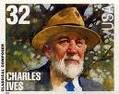
Extremely interesting post at Post-Classic in which Kyle Gann discusses variants in the Concord Sonata of Ives. Let me repeat here what I said in a comment there: it is a shame people don’t seem to be interested in preparing critical editions of scores anymore - you would think such an edition of the greatest American composition for piano would be pretty important, wouldn’t you?

Update: In a reply to my comment, Kyle Gann rightly pointed out that the Charles Ives Society has done, and is doing a lot of work on critical editions of Ives. I didn’t mean to overlook this important work - but the fashion in musicology these days is away from doing critical editions, and it seems 20th century music gets overlooked. Glad the folks working on Ives are bucking that trend.

Thursday afternoon miscellany

A few things I have been enjoying:

-Richard Thompson’s Cul de Sac is a comic strip that gets compared with Calvin and Hobbes, partly because it centers on children, but partly because it is freshly funny, with drawings to match. Read the Cul de Sac blog here, and read Thompson’s poetic collage of George W. quotes here.

-Annie Dillard made a found poem of a different kind when she made a collage of actual deathbed utterances. The poem is included in her book Mornings Like These,  and  I set it to music in my song cycle Holy the Firm (scroll down). (While the poem I set, Deathbeds, is (pardon the expression) deadly serious, Mornings Like These includes some of the funniest texts you will ever read, poor innocent paragraphs that turn out to be hysterical when taken out of context and presented as poetry.) I was interested to read a few more final words, these from famous writers, in a list that appears on the Guardian website.

- Cathy Berberian’s recordings of Stravinsky songs - Three Little Songs, Pribaoutki, Cat’s Cradle Songs - just ooze with character and charisma. Find them as part of this set.

- Barbara at Barefoot Toward the Light has posted an excerpt from a book by James Martin S.J. that is worth pondering.